
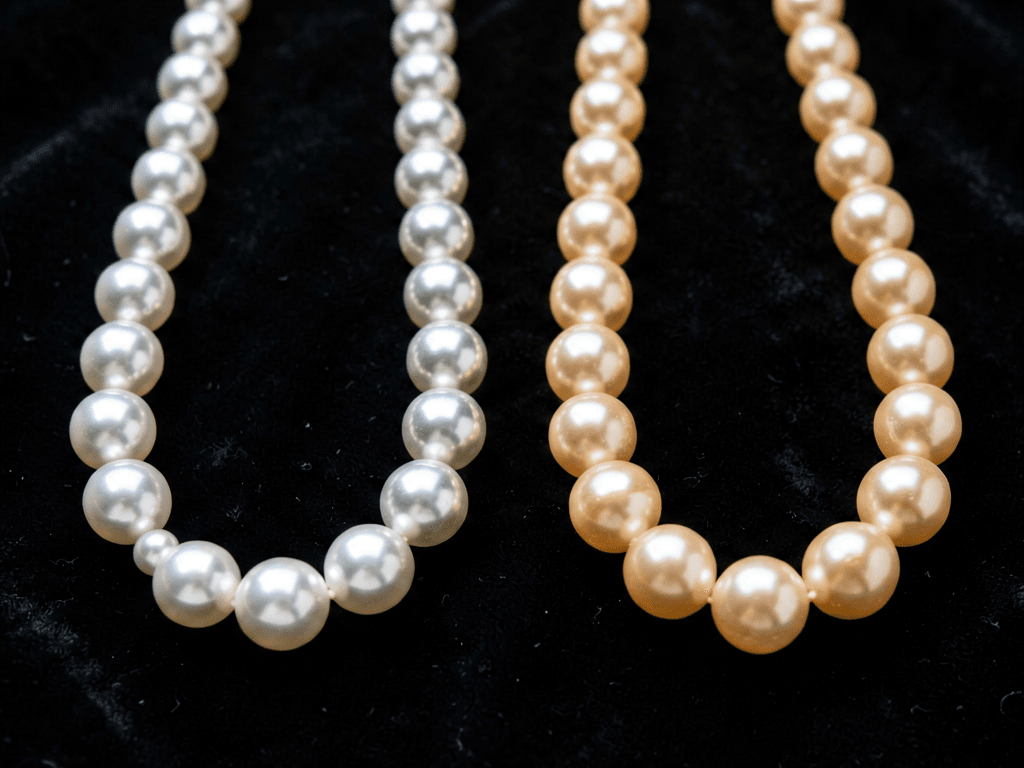
Akoya vs Freshwater Pearls: An Honest Comparison
Where They Come From: Lakes vs. Ocean
From our Zhuji market visits: A Tahitian pearl at the Ruixue stall (BC0911) was quoted at just 700 yuan (about $97), while high-luster freshwater pearls can mimic Akoya’s mirror shine at a fraction of the cost. Note that all “True Mulberry” (dark treated freshwater) pearls on the market are optimized or color-treated, a fact buyers should verify before paying premiums.
The difference starts at the source, and it explains almost everything that follows.
Akoya Pearls: The Saltwater Classic
Akoya pearls are grown in the Pinctada fucata oyster, a small saltwater oyster cultivated primarily in the coastal waters of Japan and, increasingly, China. Each oyster is nucleated with a single round shell bead plus a piece of donor mantle tissue, and it spends 10 to 18 months coating that bead in dense nacre.
The key constraint: one oyster produces only 1 to 2 pearls. That scarcity is built into every Akoya price tag. Farms even X-ray sample oysters mid-cycle to confirm the bead has held, a level of vigilance that reflects how much is at stake per shell.
Freshwater Pearls: The Lake-Born Workhorse
Freshwater pearls grow in lake and river mussels, primarily in China’s Zhuji region. Instead of a round bead nucleus, technicians graft tissue pieces alone, often a dozen or more per mussel. Each graft grows a pearl of solid nacre, with no bead inside.
One mussel can yield 20 or more pearls. That abundance is why freshwater pearls are more affordable, more varied in shape and color, and so widely available. For a deeper dive into how this process works, see our guide on How Freshwater Pearls Are Formed.
The Quick Comparison Table
| Host animal | Saltwater oyster (Pinctada fucata) | Freshwater mussels |
| Pearls per shell | 1–2 | 10–20+ |
| Nucleation | Bead + tissue | Tissue only (solid nacre) |
| Luster | Sharp, mirror-like | Soft, satiny to very good |
| Shape | Reliably round | Round through baroque |
| Typical size | 6–9 mm | 4–12 mm+ |
| Color range | White, silver-blue, cream | White, pink, peach, lavender + more |
| Durability | Good (thin nacre risk) | Excellent (solid nacre) |
| Price range | Higher ($350–$10,000+) | More accessible ($50–$700) |
Luster: The #1 Dealbreaker
If you remember one thing from this article, make it this: luster is the single most visible difference between Akoya and freshwater pearls.
Akoya’s Mirror Shine
Akoya pearls are famous for their sharp, metallic, mirror-like luster. Hold a quality Akoya under a light and you can see your own reflection on the surface: crisp edges, bright center, almost like looking at polished chrome. This is what jewelers call the “ball bearing” shine, and it’s the reason Akoya strands photograph so stunningly.
Freshwater’s Satin Glow
Freshwater pearls have a softer, warmer glow. Instead of a sharp reflection, you see a diffused, velvety sheen, like the difference between a high-gloss magazine cover and a matte-finish art print. It’s beautiful in its own way, just different.
Important caveat: Top-tier freshwater pearls, especially Edison pearls and metallic-grade specimens, are closing the luster gap. The best freshwater pearls today can approach Akoya-level shine, but at a fraction of the cost.
Shape: Perfection vs. Character
This is where personal taste really matters.
Akoya: Built to Be Round
Because Akoya pearls grow around a perfectly round bead nucleus, they come out round, reliably and consistently round. A well-matched Akoya strand looks like a string of identical billiard balls. For traditionalists and formal occasions, this uniformity is exactly the point.
Freshwater: Nature’s Sculpture
Without a bead template, freshwater pearls find their own shapes. You get near-round, oval, drop, button, and of course the wildly popular baroque freshwater pearls. For buyers who value individuality over uniformity, this variety is a feature, not a flaw.
Durability: The Underdog Wins
This surprises most people: freshwater pearls are actually more durable than Akoya.
Why Akoya Can Be Vulnerable
Akoya pearls contain a large bead nucleus, and the actual nacre coating can be thin, sometimes only 0.3–0.5mm thick. With decades of daily wear, exposure to sweat, perfume, and chemicals, that nacre can eventually wear down, revealing the bead underneath. This is called “nacre peeling,” and it’s the one real longevity risk with Akoya.
Why Freshwater Is Tough
Freshwater pearls are nearly 100% solid nacre, with no bead inside. This means there’s nothing to peel. They can take knocks, daily wear, and the rigors of an active lifestyle far better than Akoya. For everyday jewelry, this is a significant advantage. If you’re concerned about pearl care in general, our Can Freshwater Pearls Get Wet? guide covers the science in detail.
Price: What You’re Actually Paying For
The price gap between Akoya and freshwater isn’t about one being “better”. It’s about scarcity and farming cost.
| Stud earrings (7mm) | $99–$300 | $30–$80 |
| Single strand necklace (7–8mm) | $350–$2,000 | $50–$300 |
| Premium strand (Hanadama/top-grade) | $2,000–$10,000+ | $300–$700 |
Why Akoya costs more: One oyster, years of saltwater farming, one or two pearls. Each pearl carries the full cost of its animal.
Why freshwater costs less: One mussel, dozens of pearls. The cost is spread across many more gems.
Neither price is dishonest. They describe two different efforts. What you should never do is pay Akoya prices for a freshwater pearl sold without clear labeling, and unfortunately, that happens more often than you’d think.
Which Should You Choose?
Choose Akoya If:
- You want that iconic mirror-like luster above all else
- It’s a milestone gift (wedding, anniversary, graduation)
- You prefer the classic, perfectly round look
- You’re buying a piece meant to be photographed and admired
- Your budget is $400+
Choose Freshwater If:
- You want everyday jewelry you can actually wear without worry
- You like organic shapes, baroque forms, and natural color variety
- You’re buying your first pearl piece and want great value
- Durability and solid nacre matter to you
- Your budget is under $300
The Smartest Approach: Own Both
Many pearl lovers do exactly this. A freshwater strand becomes the daily go-to, the one you grab with jeans and a T-shirt. An Akoya strand waits for the evenings that call for that unmistakable shine. Together, they cover every occasion.
Pro tip: If your budget sits between the two, a shorter Akoya piece, a pendant or pair of studs, often delivers more satisfaction than a long freshwater rope chosen only for length. For specific price guidance, our Freshwater Pearl Price Guide breaks down costs by size, quality, and jewelry type.
FAQ
Can you tell Akoya and freshwater pearls apart by eye?
Often, yes. Akoya luster looks reflective and almost metallic with crisp edge definition. Freshwater luster is softer and more diffused. Roundness across a strand is another clue: Akoya strands are remarkably uniform. When in doubt, a trusted seller’s written disclosure is the final word.
Are freshwater pearls just lower quality?
No. This is a common misconception. High-quality freshwater pearls with strong luster are genuinely beautiful gems. The categories serve different purposes and budgets. Quality exists in both, and so does mediocrity. Judge the pearl in front of you, not the label.
Do Akoya pearls last a lifetime?
With proper care, yes. But because the nacre layer can be thin, Akoya pearls require more careful handling than freshwater pearls. Avoid perfume, chemicals, and prolonged exposure to sweat. Store them flat and separate from other jewelry. For detailed care instructions, see our Freshwater Pearl Grading Guide which includes care tips applicable to all pearl types.
What are “freshwater Akoya” pearls?
This is a marketing term, not a gemological category. Some sellers label round, high-luster freshwater pearls as “Chinese Akoya” or “freshwater Akoya” to command higher prices. According to the GIA, these are freshwater pearls, not Akoya, regardless of how round or shiny they are. Always ask for clear disclosure before you buy.
GIA’s own guidance is clear on why a photo alone cannot settle the question. The institute identifies a pearl by its mollusk, growing environment, and culturing method, not by how round or shiny it looks. That is the standard any seller’s written disclosure should meet.
Is it worth paying 10x more for Akoya?
It depends on what you value. Paying more for Akoya gets you 10x the rarity and that specific mirror luster, not necessarily 10x the beauty. If luster and perfect roundness are your top priorities, Akoya is worth it. If you want everyday versatility, natural colors, and solid durability, freshwater gives you far more for your money.
Get the Free Pearl Buying Checklist
7 quality checks, real price benchmarks, 5 traps to avoid, one 16-page PDF.
What the Price Gap Really Buys You
Akoya and freshwater sit at different points on the same spectrum, and the price gap is not random. Akoya farming runs on a tighter schedule: one pearl per mollusk, a bead nucleus at the core, and a shorter growing window that keeps yields low. Freshwater mussels host dozens of nuclei at once and grow for years, which is why a single freshwater harvest can outweigh an entire Akoya farm’s season. That supply difference sets the floor under Akoya pricing before any quality factor appears.
The visible payoff is consistency. Akoya pearls are bred for near-perfect roundness and a sharp, reflective luster that reads as “pearl” from across a room. Freshwater rounds have closed the gap fast, but at the top end Akoya still wins on uniform mirror shine. What you pay for is that repeatable perfection, not a different material. Both are real nacre; Akoya simply wears its nacre thinner over a shell-bead core.
For daily wear the calculus flips. Freshwater’s solid nacre shrugs off knocks that would chip a thin-skinned Akoya, and the lower price means replacing or expanding a collection costs less. If the goal is one heirloom strand for formal events, Akoya earns the premium. If the goal is jewelry you actually put on, freshwater returns more value per dollar. The mistake is assuming the higher tag always means the better pearl for your life.
Brand and origin labels add cost independent of the gem. A named Japanese Akoya line carries marketing and distribution overhead that a Zhuji freshwater strand simply does not. When two pieces look close in person, the price gap often reflects the label, not the luster. Buy the pearl you can see and verify, not the story printed on the box.
A Quick Way to Decide
If you only remember one rule: match the pearl to how often you will wear it. A formal-event heirloom favors Akoya’s mirror shine; a daily-wear collection favors freshwater’s durable nacre and fair price. Neither is wrong, and the right answer changes with the wearer, not the trend.
Free download. No spam. Unsubscribe anytime.
This akoya vs freshwater pearls comparison topic has practical implications for buyers who want to make informed decisions.
When evaluating akoya vs freshwater pearls comparison, consider multiple factors rather than relying on a single criterion.
The market for akoya vs freshwater pearls comparison continues to evolve, with new trends emerging regularly.
Understanding akoya vs freshwater pearls comparison helps buyers avoid common pitfalls and make better choices.