
When most people buy their first pearl, they often think saltwater is the only “real” option. That idea is outdated. Without knowing how the trade actually works, it’s easy to pay for a name instead of quality. The freshwater vs saltwater pearls gap has narrowed fast. Modern freshwater farming now blurs what used to be a clear line between the two.
What Exactly Are Freshwater and Saltwater Pearls?
Before you look at a single necklace, you need to know where these gems actually come from.
Freshwater Pearls: The People’s Champion
Freshwater pearls come mainly from rivers and lakes in China, with Zhuji and Changde among the best known farming hubs. Older freshwater pearls were flat, rice-shaped beads. That era is long gone. Most freshwater pearls today are tissue-nucleated: farmers insert a small piece of mantle tissue, with no shell bead. The result is a pearl made entirely of nacre. That solid build gives them thick, durable skin that holds up to daily wear. One mussel can yield dozens of pearls in a single cycle, which is part of why freshwater stays affordable.
Saltwater Pearls: The Prestige Symbol
Saltwater pearls include Japanese Akoya, South Sea, and Tahitian types, and the names alone signal a high price. They grow in the ocean, where harsh conditions keep yields low. Most are bead-nucleated, using a round shell bead at the core. That is what makes them so round and gives them a sharp, bright luster. The downside is thin skin. An Akoya’s nacre layer can be paper-thin. One scratch can ruin the pearl.
4 Core Differences in the Freshwater vs Saltwater Pearls Debate
These four points decide how much you’ll end up spending.
1. Nacre & Luster: Warm Glow vs Sharp Mirror
Saltwater pearls show a hard, glassy luster that flashes bright. Freshwater pearls give off a warm, creamy glow that seems to come from inside.
Top-tier freshwater pearls, such as Edison pearls, now have a luster that genuinely rivals saltwater types.
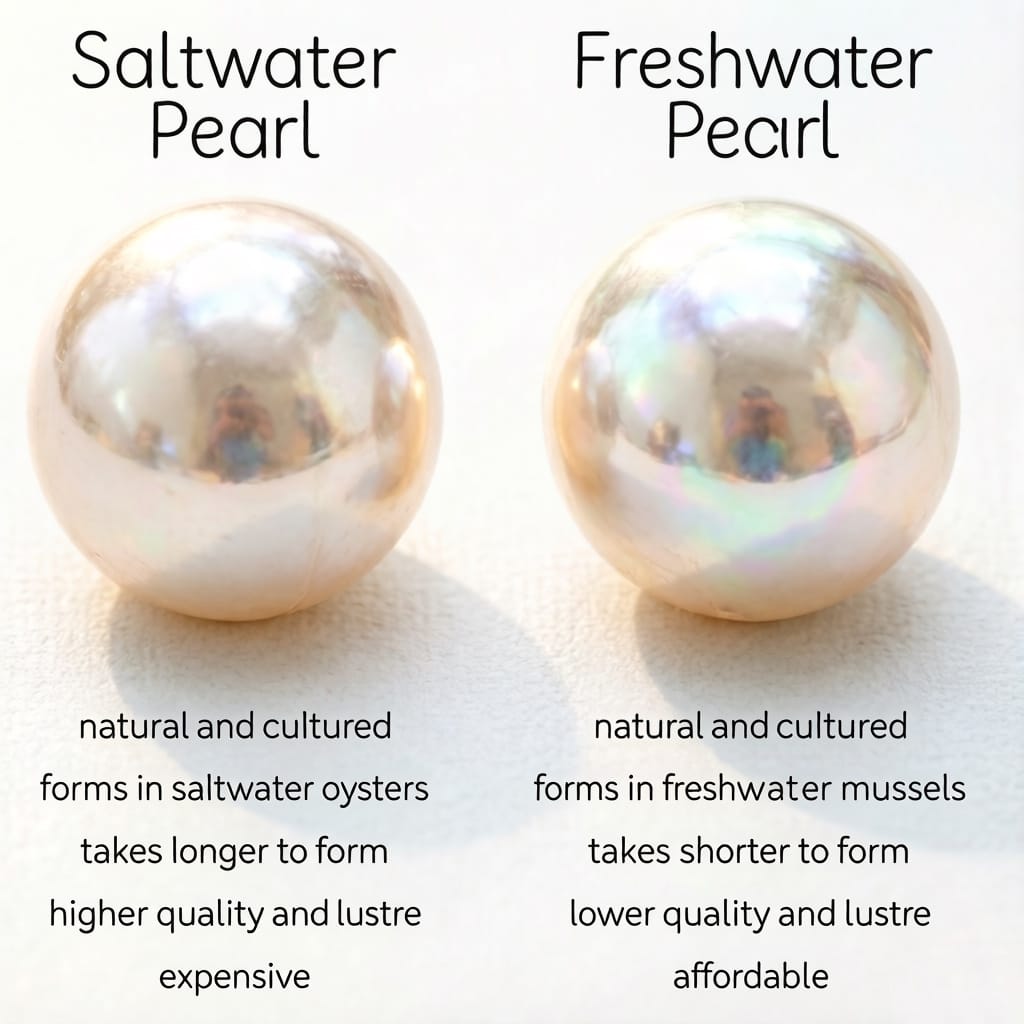
2. Shape & Perfection: Natural Charm vs Cookie-Cutter
Because saltwater pearls have a round bead core, they grow almost perfectly symmetrical. Freshwater pearls used to grow freely, but their roundness rates are now very high.
A practical rule: never chase perfect, flawless roundness. Cheap plastic fakes are perfectly round and smooth. Real natural pearls carry microscopic growth lines or tiny marks. Those are their fingerprints, not defects.
3. Durability: Which One Lasts?
Freshwater wins on durability, clearly. Because they are solid nacre, even worn surfaces are still pearl underneath. A saltwater pearl with chipped skin exposes the shell bead at its core, and the gem is ruined. Buyers who wear jewelry without much fuss should pick freshwater.
Care matters for both types. Pearls are organic: nacre is mostly calcium carbonate, and it scores only 2.5 to 4.5 on the Mohs hardness scale, so it scratches easily. The old rule is “last on, first off.” Put pearls on after perfume, makeup, and hairspray, then wipe them with a soft, slightly damp cloth after each wear. Keep them away from chlorine and sweat, store them flat and separate from harder jewelry, and have strands restrung every year or two. Thin-skinned saltwater pearls need this care even more.
The observations here come from real buyer shares on Chinese platforms such as Xiaohongshu; they reflect what shoppers report in practice, not purchases made by this site.
4. Price: Are You Paying for Quality or the Name?
A large part of the saltwater price tag is brand markup and distribution cost. For the same visual quality, freshwater pearls often cost a third or less of the saltwater price. That is why they are the smarter value pick.
For the official take on pearl grading, see GIA’s pearl quality factor guide. It is the industry standard.
Quick Comparison: Freshwater vs Saltwater Pearls Table
Here is the comparison in plain data.
| Feature | Freshwater Pearls | Saltwater Pearls |
|---|---|---|
| Origin | China (Zhuji, Changde, etc.) | Japan, Australia, French Polynesia |
| Nacre Thickness | Extremely thick (solid nacre) | Thin (approx. 0.1-0.5mm) |
| Shape | Diverse (near-round, oval, baroque) | Mostly perfectly round |
| Luster | Warm, soft, creamy | Sharp, mirror-like |
| Durability | High (resists chipping) | Low (thin skin wears easily) |
| Price Range | Affordable ($50 – $1,000+) | Expensive ($300 – $100,000+) |
| Main Varieties | Standard Freshwater, Edison | Akoya, South Sea, Tahitian |
Why Modern Freshwater Pearls Are Closing the Gap
Chinese pearl farms have been improving fast over the last few years. Freshwater pearls used to be entry-level only. Now varieties like the “Edison” pearl are large, round, and very bright. Farmers even grow natural purples and golds without irradiation or dye.
China now produces 95% of the world’s freshwater pearls. With that output, farming techniques keep evolving quickly. For more on this shift, read Wikipedia’s introduction to cultured freshwater pearls.
For readers who want to move past theory and actually test pearls at home, there is a step-by-step guide here: pearldecoded.com/how-to-tell-if-freshwater-pearls-are-real/
Who Should Buy Freshwater vs Saltwater Pearls?
Don’t let sales clerks upsell you. What fits your life is what matters.
Buy Freshwater Pearls if:
- You want max quality on a budget: A few hundred dollars gets you an entry-level saltwater strand, but a top-tier freshwater piece.
- You wear jewelry daily: Toss it on for work or brunch without worrying about chipping the nacre.
- You love unique designs: Baroque freshwater pearls offer artistic vibes that cookie-cutter rounds just can’t match.
Buy Saltwater Pearls if:
- You want an heirloom piece: The absolute scarcity of top-tier saltwater pearls holds strong collectible value.
- You crave mirror luster and perfect rounds: That razor-sharp glow is still the holy grail, though freshwater is catching up fast.
- You need to impress at a major event: For weddings or galas, the “prestige” of a saltwater pearl definitely turns heads.
Practical Buying Notes
How to Read a Pearl Certificate
Most freshwater pearls sold today skip third-party grading, which is why a certificate matters more than the logo printed on it. A useful certificate names the pearl type, whether it is bead- or tissue-nucleated, the nacre thickness when measured, and the origin. For freshwater strands, look for a statement that the pearls are solid nacre rather than coated shell. Self-issued “AAA” grades carry no independent meaning; a lab name such as GIA, GIC, or a recognized Chinese gem lab is what gives a certificate weight. When a seller cannot name the lab, treat the grade as marketing. For everyday purchases under a few hundred dollars a certificate is optional, but for pieces above the keeper threshold it protects you if the pearl is ever questioned or resold.
What Size to Choose by Use
Size follows function. Stud earrings in 7-8mm read as everyday subtle. Pendants from 8-10mm suit most necklines without overwhelming them. Strands at 9-11mm read formal and pair with occasion wear. Baroque pieces can run larger, 11-14mm, because their irregular shape spreads the visual weight. Bigger is not better: a 12mm round freshwater pearl is impressive but can feel heavy on a thin chain. Match diameter to the wearer and the setting, not to the seller’s pitch.
Care That Preserves Luster
Restringing matters more than buyers expect. A worn silk thread snaps without warning, and a lost strand is gone. Have strands checked yearly; if the thread looks fuzzy or discolored near the clasp, restring now. Store pearls flat, never hanging, because gravity pulls the thread and the pearls can rub. Keep them away from cosmetics, hairspray, and perfume, which dull nacre faster than age. A quick wipe with a soft damp cloth after wear removes skin oils that otherwise etch the surface over years.
The Resale Reality
Resale differs sharply between the two. Saltwater Akoya from a named brand can hold value, but most commercial pearls resell for a fraction of retail because supply is large and demand is personal. Freshwater pearls, being abundant, rarely appreciate; buy them for wear, not investment. If resale matters, keep the certificate and the original packaging, buy from a seller who can re-authenticate, and avoid pieces whose value rests on a grade alone.
Three Mistakes Buyers Repeat
Three mistakes show up constantly. First, paying for “perfect round” in freshwater and getting a coated fake. Second, trusting a live-stream “elder discount” without a static proof photo. Third, assuming a high price means saltwater. Many $300 “Akoya” strands sold online are freshwater with a saltwater label. Verify the nucleus claim: bead-nucleated saltwater has a shell-bead core; tissue-nucleated freshwater is all nacre. A jeweler with an x-ray or a density test can tell them apart in minutes.
When Freshwater Wins on Purpose
Choose freshwater when the plan is daily wear, gifting, or a first real pearl. The thick nacre shrugs off the small knocks of everyday life, and the price leaves room to buy more than one. Saltwater earns its place for heirloom pieces, formal events, or when the wearer wants the mirror luster that only thin-skinned Akoya delivers. Neither is “better”; they serve different wrists and different budgets. The mistake is letting the label decide instead of the use.
Frequently Asked Questions About Freshwater vs Saltwater Pearls
Q1: Are freshwater pearls fake?
No. If a living mollusk created it, it’s a real pearl. Both types are organic gems. The fakes are the ones made of plastic or coated glass.
Q2: Do freshwater pearls peel?
Normal freshwater pearls are solid nacre and will not peel. If your “freshwater” pearl is peeling, you likely bought a cheap imitation made of powdered shell or coated plastic.
Q3: Why are saltwater pearls so expensive?
Low yield and high risk. Ocean farming faces typhoons and red tides, survival rates are low, and heavy brand marketing from Japan drives the prices up.
Q4: How long do freshwater pearls last?
With basic care, a lifetime. Because they are solid nacre, they actually get creamier and more lustrous over time. Thin-skinned saltwater pearls might look worn out after a decade or two.
Q5: Can you tell freshwater and saltwater pearls apart by eye?
It’s very hard now, especially with top-tier freshwater. The most accurate way is checking a gem certificate or having a professional look at the nacre structure.
About the Author:
Pearl Decoded is run by a team based in Zhuji, China’s freshwater-pearl hub. The goal is plain talk, no fluffy jargon, just a straight account of how the pearl trade really works. Skip the “stupid tax” and shop with clear eyes.
https://pearldecoded.com/how-to-tell-if-freshwater-pearls-are-real/
Get the Free Pearl Buying Checklist
7 quality checks, real price benchmarks, 5 traps to avoid, one 16-page PDF.
Free download. No spam. Unsubscribe anytime.
This freshwater vs saltwater pearls topic has practical implications for buyers who want to make informed decisions.
When evaluating freshwater vs saltwater pearls, consider multiple factors rather than relying on a single criterion.
The market for freshwater vs saltwater pearls continues to evolve, with new trends emerging regularly.
Understanding freshwater vs saltwater pearls helps buyers avoid common pitfalls and make better choices.