
A single freshwater mussel can yield a surprising number of pearls at once. In one documented harvest, a grower opened a mussel and pulled out forty perfectly round freshwater pearls, a result that changes how most people understand how freshwater pearls are formed.
Most people picture pearls as rare, one-per-oyster treasures. That image is decades out of date. To understand how freshwater pearls are formed, set the old textbook version aside and look at what actually happens on a modern farm.
Here’s the short version: freshwater pearls form through a process that is part biology, part craftsmanship, and a whole lot of patience.
This article walks through exactly how freshwater pearls are formed, from the inside out. For the full picture on freshwater pearls beyond formation, check out our Complete Guide to Freshwater Pearls.
What Exactly Is a Freshwater Mussel?: And How Are Freshwater Pearls Formed Inside It?
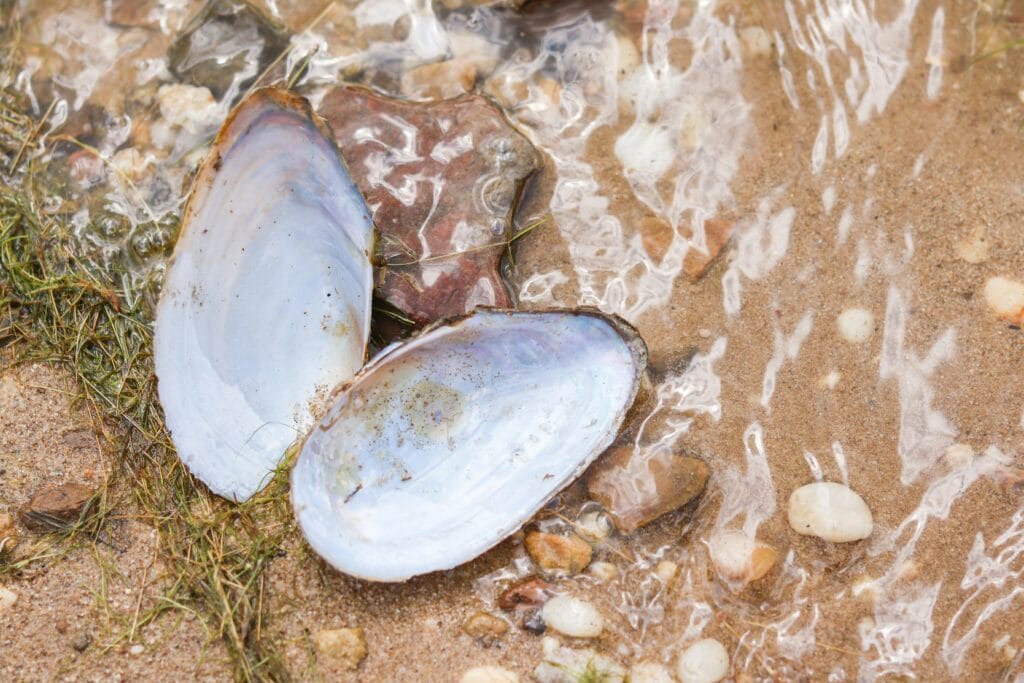
Before the pearls, look at the creature that makes them.
Freshwater pearls come from mussels rather than oysters, and the distinction matters. These mussels live in rivers and lakes, with the largest growing regions in China’s Zhejiang and Hunan provinces.
The key species used for pearl farming is Hyriopsis cumingii, often called the “triangle shell mussel.” It is bigger than a human hand and can live for over a decade in the right conditions.
What makes it special is output. Saltwater oysters typically produce one pearl at a time, while a single freshwater mussel can grow 20 to 50 pearls at once. That single fact reshapes the entire economics of the industry.
How Freshwater Pearls Are Formed: The Natural Process
Here is where the biology gets interesting.
Step 1: Something Gets Inside
A pearl starts when an irritant (a parasite, a grain of sand, or a tiny piece of organic matter) slips inside the mussel’s shell and lodges in its soft mantle tissue. The mussel cannot scratch or remove it, so it does the only thing available. It fights back.
Step 2: Nacre Starts Building
The mussel’s mantle secretes a substance called nacre (also known as mother-of-pearl) to coat the irritant. Nacre is built from microscopic aragonite platelets held together by a protein called conchiolin. Layer after layer, the nacre wraps around the intruder like an onion.
This is not fast. Each layer of nacre is incredibly thin, about 0.5 microns (roughly 1/200th the thickness of a human hair). A pearl needs thousands of these layers before it becomes anything worth wearing.
Step 3: Time Does the Rest
A natural freshwater pearl takes 2 to 6 years to form. The longer it stays in the mussel, the thicker the nacre becomes, and the richer the luster. This is why older pearls carry that deep, warm glow that newly harvested ones cannot match. There is simply more material for light to travel through and reflect back.
According to the USGS’s explanation of how pearls are formed, this biological process has not changed in millions of years. Nature’s version of making lemonade out of lemons.
Cultured vs Natural: What Really Happens on a Pearl Farm
The practical reality: almost all freshwater pearls sold today are cultured. “Natural” freshwater pearls, the kind that form without any human intervention, do exist, but they are extremely rare and wildly expensive. In nature, roughly 1 in 10,000 mollusks ever produces a pearl, and most of those are small and misshapen, which is why a genuine natural pearl commands a steep premium. If someone offers you “natural” pearls at a discount, walk away.
How Cultured Freshwater Pearls Are Made
On a farm, humans give nature a head start:
- Grafting (implantation): A skilled technician cuts small pieces of mantle tissue from a donor mussel and implants them into the recipient mussel’s mantle. Notice that there is no shell bead involved. This is what sets freshwater pearls apart from most saltwater ones. Each tiny tissue piece becomes the nucleus around which nacre builds.
- One mussel, many pearls: A single freshwater mussel can receive 20 to 50 tissue implants. That is why freshwater pearl production runs so much higher than saltwater. Each implant has the potential to become a pearl.
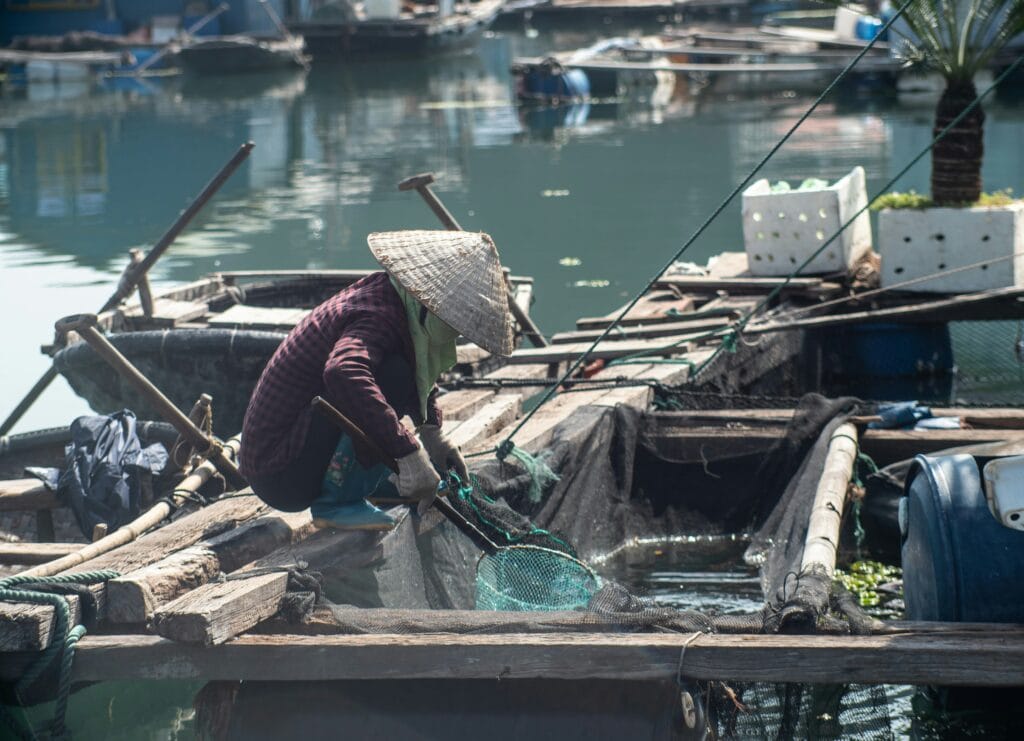
- Back to the water: The mussels are returned to the farm’s lakes or rivers, suspended in nets or baskets where they are monitored for water quality, temperature, and food supply.
- The wait: For 2 to 6 years, the mussels do their work, filtering water, eating, and slowly coating each tissue nucleus with nacre. Farmers check on them regularly, but mostly it is a waiting game.
- Harvesting: When the pearls are ready, farmers open the mussels and collect the pearls. The best mussels can produce a stunning range of shapes, sizes, and colors from a single harvest.
The grafting step decides the entire quality outcome. A technician with steady hands shapes the result in about 30 seconds per mussel, which is surgical precision rather than mass production. The epithelial cells from the grafted mantle tissue multiply and form a pearl sac that surrounds the nucleus and deposits the nacre.
The key difference: because freshwater cultured pearls are tissue-nucleated (not bead-nucleated), the entire pearl is solid nacre. There is no shell bead core like in Akoya or South Sea pearls. This matters greatly for durability, a point worth keeping in mind.
From Mussel to Jewelry: How Freshwater Pearls Are Formed Into Wearable Gems
Getting pearls out of a mussel is only the start. What happens next decides whether those pearls end up on a luxury site or in a bargain bin.
1. Harvesting & Sorting
Freshwater pearls come out of the mussel covered in organic slime. They are washed immediately, then sorted by size, shape, color, and luster. This is where the first major culling happens. Maybe 5% of a harvest qualifies as gem-grade.
2. Cleaning & Drilling
Good pearls do not need much processing. A light tumble in salt and water removes residual organic material. Then they are drilled, either halfway through (for necklaces strung on silk) or all the way through (for earrings and pendants). Drilling is risky. One slip and a valuable pearl becomes a bead.
3. Grading & Matching
Grading freshwater pearls follows the GIA’s 7 Pearl Value Factors: size, shape, color, luster, surface quality, nacre quality, and matching. Matching is especially important for necklaces. Finding 40+ pearls that look like siblings is an art in itself.
A single necklace can take hours of matching. Sorters sit with trays of thousands of pearls and pick out the ones that belong together by eye. Machines help with size sorting, but color and luster matching remains a human skill.
4. Setting into Jewelry
Finally, the matched pearls are strung on silk thread with knots between each pearl (so you do not lose the whole strand if it breaks) or set into metal findings for earrings, rings, and pendants.
Freshwater vs Saltwater Pearl Formation: The Key Differences
Since the topic is how freshwater pearls are formed, it helps to see how the process differs from saltwater pearl formation. We covered this in depth in our freshwater vs saltwater pearls guide, but here is the quick comparison:
| Factor | Freshwater Pearls | Saltwater Pearls |
|---|---|---|
| Nucleation | Tissue piece (no bead) | Shell bead + tissue piece |
| Nacre composition | 100% solid nacre | Thin nacre over bead core |
| Pearls per mollusk | 20–50 | 1–2 (rarely more) |
| Farming time | 2–6 years | 1–3 years (Akoya), 2–4 years (South Sea) |
| Shape tendency | More varied (round, oval, baroque) | Rounder due to bead nucleus |
| Durability | Excellent (solid nacre won’t peel) | Lower (thin nacre can chip or peel) |
| Primary locations | China (Zhuji, Changde) | Japan, Australia, French Polynesia |
The solid nacre point is worth emphasizing. Because freshwater pearls are formed around a tissue piece (not a bead), every millimeter of that pearl is genuine nacre. Saltwater pearls, formed around a shell bead, might have nacre so thin you can see the bead through it. That is why freshwater pearls are more durable for daily wear. They cannot “peel” because there is nothing underneath to expose.
Why Understanding Pearl Formation Matters for Buyers
Understanding how freshwater pearls are formed directly determines what you pay and what you get.
You might be thinking, “This is interesting, but why should I care how freshwater pearls are formed?“
Because the formation process directly determines:
- Durability: Solid nacre freshwater pearls will outlast thin-nacre saltwater ones. If you want everyday jewelry, formation method matters.
- Value: Knowing that tissue-nucleated pearls are solid nacre helps you understand why some freshwater pearls are genuinely worth more than cheap saltwater ones.
- Authenticity: If someone claims a pearl is “natural,” understanding the farming process helps you call out the bluff. Natural freshwater pearls are vanishingly rare. Wikipedia’s entry on cultured freshwater pearls notes that the vast majority of today’s supply comes from farms. Want to verify your own pearls? Read our guide on how to tell if freshwater pearls are real.
- Appreciation: When you understand that each pearl represents 2–6 years of a living creature’s work, you stop seeing it as just a bead and start seeing it as what it is: a biological marvel.
About the Author
This guide is written by Li, who has spent over a decade around freshwater pearl farms and the biology of how mussels build nacre. The aim is plain talk on the science, no lab-coat jargon, just a clear look at what really happens inside the shell.
Frequently Asked Questions About How Freshwater Pearls Are Formed
Q: How long does it take for a freshwater pearl to form?
Typically 2 to 6 years on a farm. Natural pearls can take even longer. The longer the formation period, the thicker the nacre and the richer the luster.
Q: Are cultured freshwater pearls real pearls?
Yes. A cultured pearl is formed by a living mussel using the exact same biological process as a natural pearl. The only difference is that humans initiated the process by implanting the tissue. The nacre is 100% real.
Q: How many pearls can one freshwater mussel produce?
A single mussel can produce 20 to 50 pearls at once, because farmers implant multiple tissue pieces. This is vastly different from saltwater oysters, which typically produce just 1 pearl.
Q: Why are freshwater pearls cheaper than saltwater?
Higher yield per mussel, lower farming risk (lakes vs oceans), and massive scale in China. Cheaper does not mean inferior. The solid nacre composition of freshwater pearls actually makes them more durable.
Q: Can freshwater pearls form without human help?
Yes, natural freshwater pearls can form without human intervention. It is extremely rare. Natural freshwater pearls form when an irritant accidentally enters the mussel. These wild pearls are valuable collector’s items and almost never end up in commercial jewelry.
Q: Do freshwater pearls come from oysters or mussels?
Freshwater pearls come from freshwater mussels (Hyriopsis cumingii), not oysters. A single mussel can produce 20 to 50 pearls simultaneously, unlike oysters which typically produce one pearl at a time.
Q: How is freshwater pearl nacre different from saltwater pearl nacre?
Freshwater pearls are virtually all solid nacre with no shell bead nucleus inside. Saltwater pearls (Akoya, Tahitian, South Sea) typically have a small shell bead at their core with nacre coating around it. This makes freshwater pearls more durable. Their luster deepens over time rather than wearing thin.
Q: What affects the quality of a freshwater pearl?
Key factors include: luster (depth of shine), surface quality (cleanliness of blemishes), shape (roundness), size (diameter in mm), and color (body color plus orient/rainbow overtones). Nacre thickness is the foundation of all these qualities. For a complete buying guide covering all these factors, see our freshwater pearl necklace buying guide.
Get the Free Pearl Buying Checklist
7 quality checks, real price benchmarks, 5 traps to avoid, one 16-page PDF.
Free download. No spam. Unsubscribe anytime.