
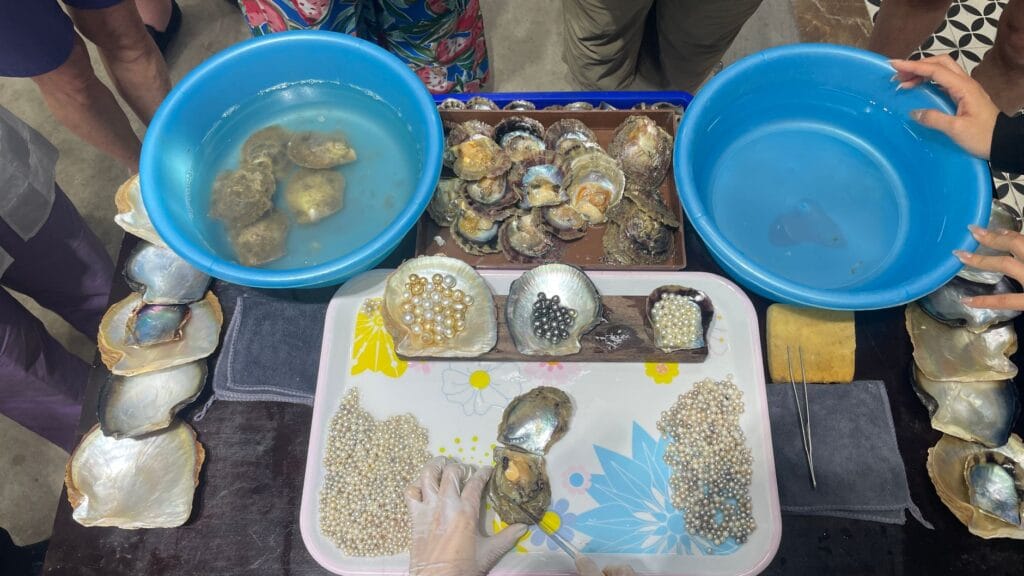
Every freshwater pearl you wear started inside a living mussel. It was bred, nucleated, monitored, and harvested over months or years by people who understand the animal as well as the gem. Freshwater pearl farming is the backbone of the global pearl industry, producing over 90% of all cultured pearls sold today.
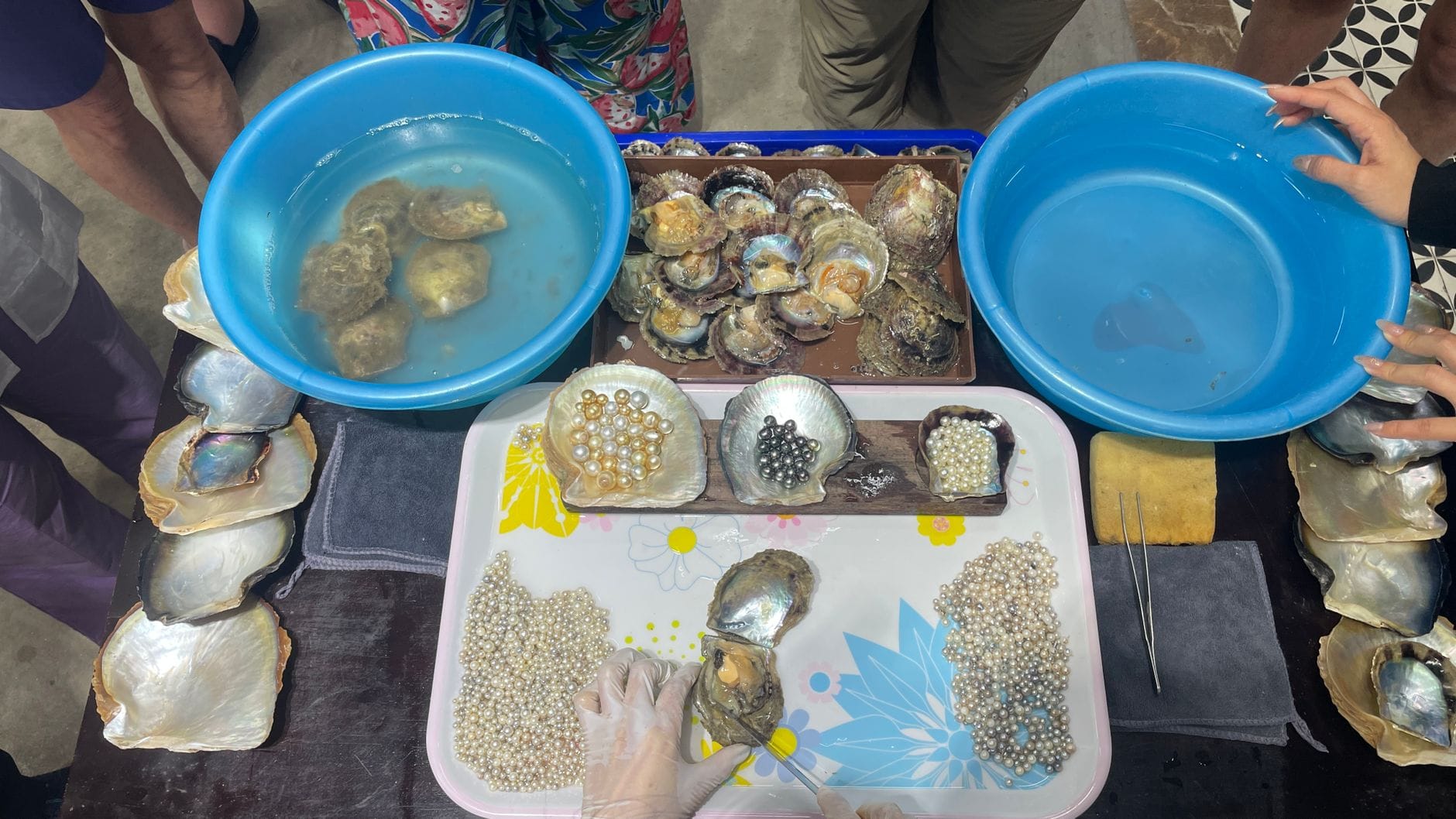
Yet most buyers never learn what actually happens on the farm. Understanding the process changes how you evaluate quality, judge price, and spot marketing claims that do not match reality.
Why Freshwater Pearl Farming Matters to You as a Buyer
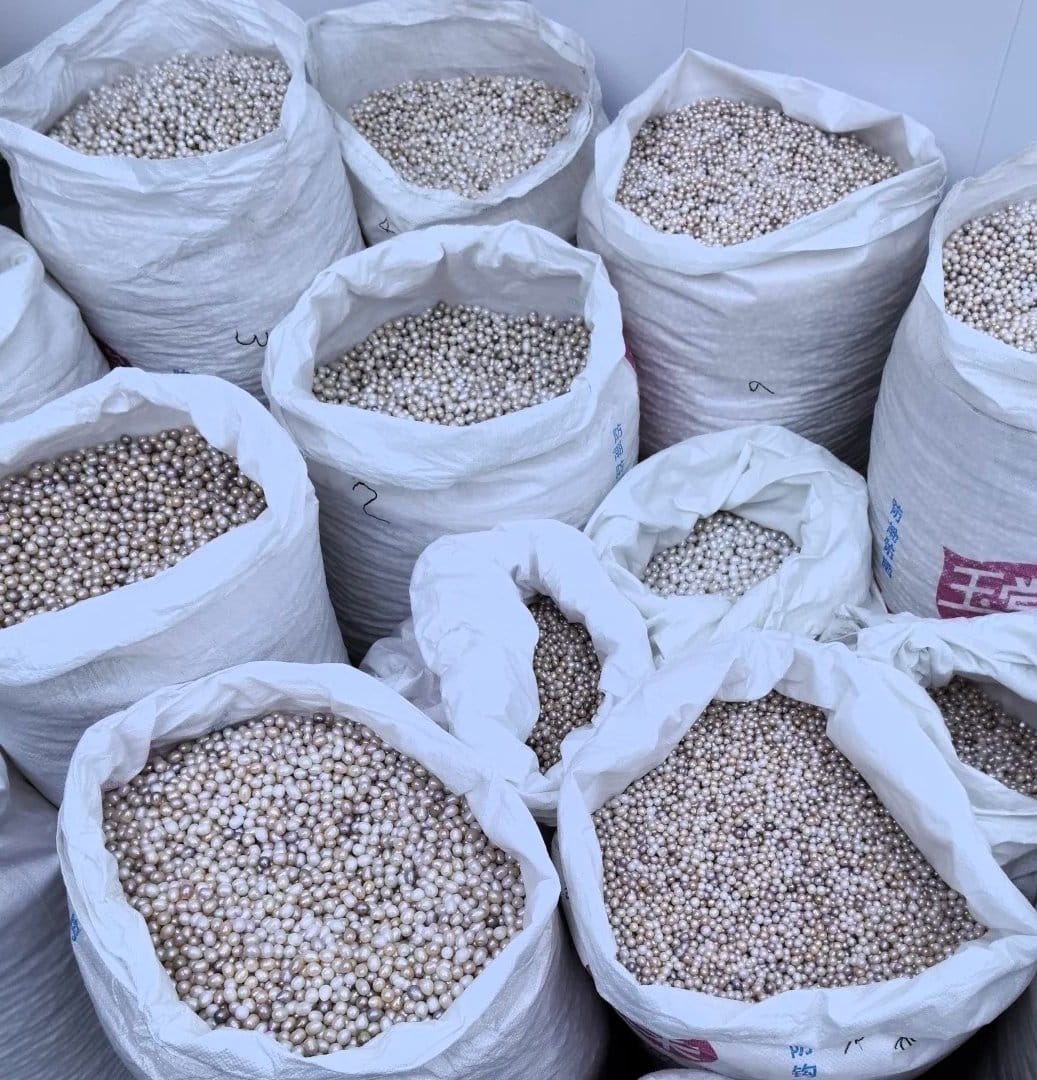
Most pearl guides skip the farm entirely and jump straight to grading. That is backwards. Quality on a freshwater pearl is not random. It is a direct result of farming decisions.
Which mussel species the farmer chose, how many nucleations they attempted, how long they let the pearl grow, and whether they prioritized volume or individual quality: these choices determine every quality factor you see in the finished pearl.
When you know what happens on the farm, three things become obvious that most buyers miss:
- Why some freshwater pearls look better than Akoya pearls costing three times more: the farmer simply invested more time and care in each individual pearl
- Why “AAA grade” means nothing without farm context, a rushed harvest on an overloaded mussel produces the same surface grade as a patient harvest on a healthy one, but the luster and nacre thickness are completely different
- Why Chinese freshwater pearls dominate the market: the farming infrastructure, breeding programs, and scale in China’s pearl regions have no equivalent anywhere else
The Chinese freshwater pearls guide explains the regional geography. This article goes deeper: into the actual biological and mechanical process that turns a mussel into a gem factory.
The 6-Step Freshwater Pearl Farming Process
Step 1: Mussel Breeding and Selection
Freshwater pearl farming begins with the mussel, not the pearl. Chinese farms primarily use two species:
- Hyriopsis cumingii (the triangle shell mussel) produces larger pearls with thicker nacre, the backbone of modern Chinese freshwater pearl farming since the 1990s
- Cristaria plicata (the cockscomb mussel) is the older species, producing smaller pearls with thinner nacre, largely replaced by triangle shell mussels for quality production
Modern farms do not just collect wild mussels. They run controlled breeding programs, selecting parent mussels with desirable shell thickness, growth rate, and disease resistance. The FAO fisheries division documents how selective breeding in Chinese pearl farms has doubled average pearl size over two decades while improving nacre consistency.
Baby mussels (spat) are raised in nursery tanks for 6-12 months before they are strong enough for nucleation. A farm that skips this step (collecting wild adults and nucleating immediately) produces weaker pearls because the mussel has not been conditioned to handle the stress of insertion.
What this means for you: Pearls from farms with breeding programs (most quality Chinese operations today) have better underlying health than pearls from wild-caught or unconditioned mussels. When a seller mentions “farm-raised” or “cultivated,” they are not just using buzzwords. They are describing a real quality advantage.
Step 2: Nucleation : The Critical Decision
This is where freshwater pearl farming diverges dramatically from saltwater pearl farming, and the divergence explains almost every quality difference you see in the final product.
Saltwater pearl farming inserts a round bead nucleus (usually from a Mississippi River pig-toe shell) plus a small piece of donor mantle tissue into the oyster’s gonad. The oyster coats the bead with nacre.
Result: the pearl’s shape is mostly defined by the bead, so roundness is common but nacre thickness is thin (0.3-0.8mm typical for Akoya).
Freshwater pearl farming historically inserted only a small piece of donor mantle tissue (1-2mm) into the mussel’s mantle cavity. No bead. The tissue piece itself becomes the nucleus, and the mussel coats it entirely with its own nacre.
Result: the pearl is 100% nacre (no bead core), but shape is unpredictable because a tiny tissue square does not provide a round template.
This tissue-only method produces what the industry calls “tissue-nucleated” freshwater pearls. The classic type dominated the market until the 2000s. Their key properties:
- 100% nacre composition (no bead core to wear through)
- Wide shape variety (round, oval, baroque, button: all from the same farm)
- Higher durability because thick nacre resists chipping
- Lower roundness rate (only 2-5% of a typical harvest are near-round)
Modern freshwater pearl farming has added bead nucleation for specific products. Edison pearls and other large round freshwater pearls use bead nuclei inserted into the mussel’s body cavity.
This hybrid approach (similar to saltwater technique but in a different mussel location) produces rounder, larger pearls. The Edison pearls guide covers this in detail.
What this means for you: If a freshwater pearl is described as “all-nacre” or “solid nacre,” it was tissue-nucleated. Thicker and more durable, but shape will vary. If it is described as perfectly round and 10mm+, it was likely bead-nucleated. Shape is more consistent, but nacre may be thinner over the bead.
Step 3: How Many Pearls Per Mussel : The Volume vs Quality Trade-Off
One triangle shell mussel can accept 20-40 nucleations simultaneously across its two mantle lobes. This is the single biggest structural advantage of freshwater pearl farming over saltwater (where one oyster produces one pearl, sometimes two).
But there is a trade-off the industry rarely discusses openly. A mussel producing 30 pearls divides its nacre production across 30 sites. A mussel producing 5 pearls concentrates that same nacre output on 5 sites. The math is simple:
| Nucleations per mussel | Typical nacre thickness | Typical luster quality | Typical shape consistency |
|---|---|---|---|
| 15-20 (moderate) | Medium (1-2mm solid nacre, nucleus-free) | Good luster | Moderate |
| 5-8 (quality-focused) | Solid nacre (whole pearl is nacre; 6–12mm common) | Sharp, mirror luster | High (more near-round) |
What this means for you: Price differences between “similar looking” freshwater pearls often reflect different nucleation counts, not just grading labels. A $30 strand and a $300 strand might both come from Hyriopsis cumingii. The cheap one grew in a mussel carrying 35 other pearls, the expensive one in a mussel carrying only 5. The nacre thickness and luster difference is visible under good lighting, even when both are labeled “AAA.”
Step 4: The Growing Period : Time Is the Hidden Quality Variable
After nucleation, freshwater pearl farming enters a waiting phase that ranges from 6 months to 5 years depending on the farm’s goals.
The biology is straightforward: mussels secrete nacre layers around the nucleus at a rate determined by water temperature, food availability, and mussel health. In warm months (summer in Chinese pearl regions), nacre deposition accelerates. In cold months, it slows or pauses. This seasonal rhythm creates visible concentric layers inside the pearl, like tree rings.
| Growing period | What the farm gets | Typical use case |
|---|---|---|
| 1-2 years | Medium pearls (7-9mm), moderate nacre, good luster | Mid-range jewelry |
| 3-5 years | Large pearls (9-14mm), thick nacre, mirror luster | Premium, collector-grade |
A farm that harvests at 6 months is making a volume decision: get product to market fast, accept lower per-pearl quality. A farm that waits 3+ years is making a quality decision: sacrifice cash flow for premium output.
According to the Gemological Institute of America, nacre thickness is the single most important durability factor, and it correlates directly with growing time.
What this means for you: When a seller does not mention growing time or nacre thickness, you should ask. The difference between a 1-year and 3-year freshwater pearl is not visible in a product photo, but it determines whether the pearl lasts 5 years or 50 years.
Step 5: Harvesting and Initial Sorting
Harvesting in freshwater pearl farming happens in two phases:
- First harvest (mantle positions): The mussel is opened carefully, and pearls from the mantle lobes are removed. The mussel may be nucleated again for a second crop if it is still healthy. This is why freshwater pearl farming is more sustainable than saltwater (where the oyster typically dies after one harvest).
- Second harvest (body cavity positions): If bead-nucleated pearls were placed in the mussel’s body cavity (for Edison-style production), they are removed separately.
After harvest, pearls go through an initial sort that separates them into rough categories:
- Keepers (2-5%): near-round, good luster, clean surface: candidates for premium jewelry
- Commercial grade (15-25%): acceptable shape and luster: mid-range jewelry
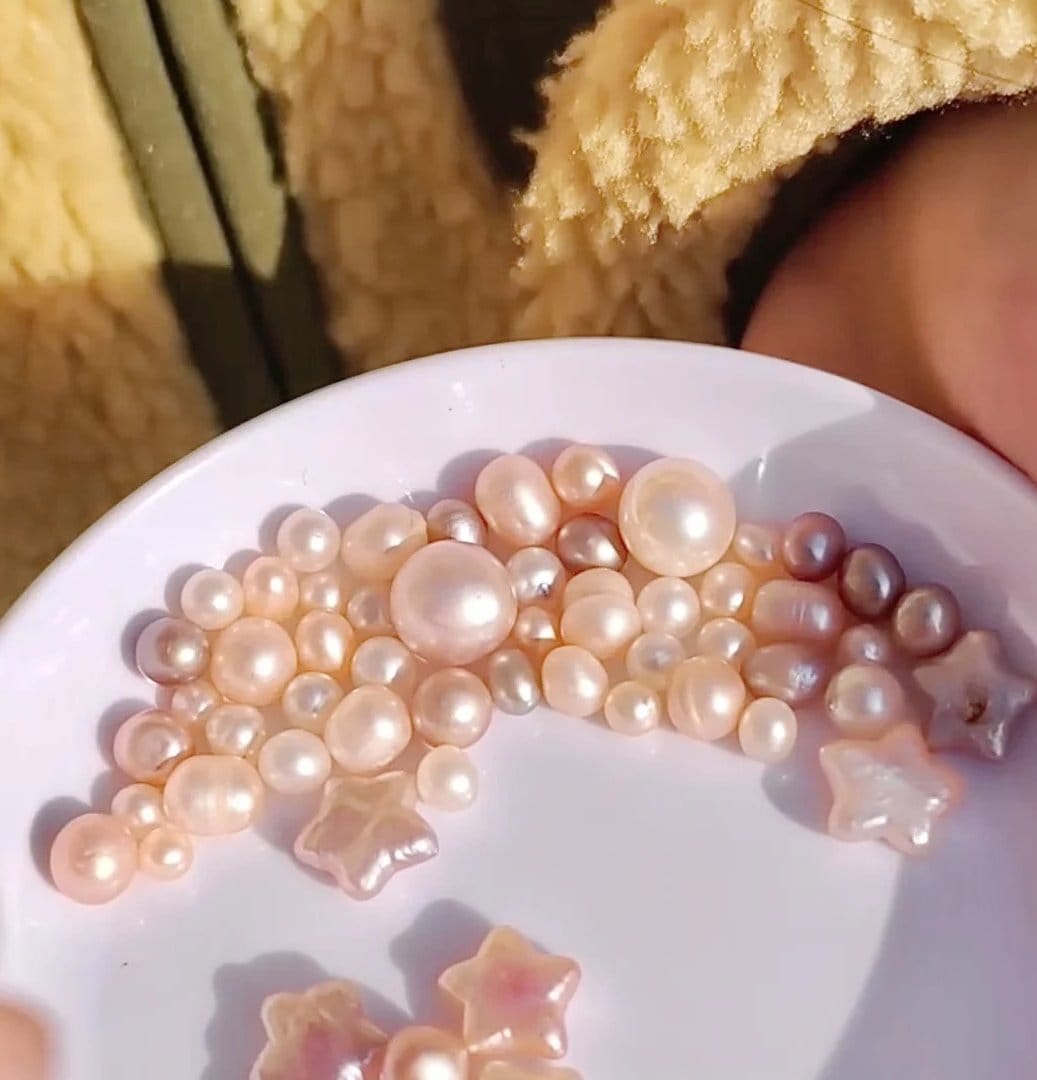
- Craft grade (60-80%): baroque, low luster, or blemished: used for bead strands, crafts, or lower-end jewelry
This 2-5% keeper rate is why high-quality freshwater pearls command premium prices despite the overall industry producing millions of pearls per year. Volume is high, but top-quality volume is low.
What this means for you: The freshwater pearl grading guide explains how dealers label these categories. The farming context tells you why the categories exist: most freshwater pearls are baroque or off-round because tissue nucleation in an overloaded mussel does not produce precision shapes.
Step 6: Processing : From Farm Raw to Jewelry Ready
Raw freshwater pearls from the farm look different from finished jewelry pearls. The processing steps are:
- Washing: Pearls are cleaned in mild soap solutions to remove organic residue and mucus
- Tumble polishing: Mild mechanical polishing smooths minor surface irregularities. This is standard and accepted in the industry
- Bleaching (controversial): Some farms bleach pearls to lighten dark spots or even out color. This reduces luster and is considered a quality downgrade by knowledgeable buyers
- Color treatment: Dyeing or irradiation to create “exotic” colors (chocolate, peacock, etc.). Always disclosed by reputable sellers, often hidden by others
The guide on how to clean pearls covers post-purchase care. For farm-level processing, the key fact is: the less processing a pearl receives, the better it is. A truly premium freshwater pearl goes from harvest to jewelry with only washing and light tumbling. Anything beyond that is fixing problems the farm created.
What this means for you: Ask whether pearls are “natural color” or “treated color.” Natural color freshwater pearls come in white, pink, peach, lavender, and cream. All are produced by the mussel itself. Any other color (chocolate, deep blue, vivid gold) is almost certainly treated, and the treatment may have compromised the surface quality.
Freshwater vs Saltwater Pearl Farming: The Structural Difference
Understanding freshwater pearl farming requires comparing it to saltwater, because marketing often implies the saltwater method is inherently superior. It is not. It is simply different.
| Factor | Freshwater pearl farming | Saltwater pearl farming |
|---|---|---|
| Habitat | Lakes, rivers, ponds | Coastal ocean waters |
| Nucleation | Tissue-only (traditional) or bead (Edison) | Bead + tissue (always) |
| Pearls per animal | 20-40 (tissue) or 1-2 (bead) | 1 (sometimes 2) |
| Nacre composition | 100% (tissue) or mixed (bead) | Thin layer over bead |
| Survival after harvest | High (can re-nucleate) | Low (oyster often dies) |
| Typical nacre thickness | 1-4mm | 0.3-0.8mm (Akoya) |
| Environmental risk | Water pollution, algae blooms | Ocean warming, disease, typhoons |
| Scale | Factory-scale operations | Small artisan farms |
The sustainability advantage is significant. Freshwater pearl farming reuses mussels across multiple harvests and operates in controlled freshwater environments.
Saltwater pearl farming harvests oysters destructively and depends on increasingly volatile ocean conditions. This structural difference matters both environmentally and economically.
Real farms are now putting hard numbers on that sustainability story. In May 2025, the FAO added Deqing County’s fish-mussel co-culture pearl system to its Globally Important Agricultural Heritage Systems list, the first aquaculture entry from China. The model is old but practical: fish waste feeds the mussels, and the mussels filter the water while they grow pearls. One visible trade-off is time. Eco-focused farms using this approach stretch the growth cycle to five or six years, against the one- to two-year cycle of intensive operations that chase volume. Buyers feel that patience as thicker nacre and cleaner luster. Meanwhile a single town, Shanxiahu in Zhuji, still supplies more than 70% of the world’s freshwater pearls, which is exactly why farming choices made there ripple into every price tag.
For a deeper comparison, see our freshwater vs saltwater pearls guide.
What Freshwater Pearl Farming Knowledge Does for Your Buying Decisions
Knowing how freshwater pearl farming works does not just make you informed. It changes three practical buying decisions:
1. You stop overpaying for “saltwater superiority.” An Akoya pearl with 0.3mm nacre over a bead core is not inherently superior to a freshwater pearl with 3mm solid nacre.
The saltwater pearl has a rounder shape because it grew on a round bead, not because the oyster is better. When durability matters (everyday wear, heirloom pieces), thick-nacre freshwater pearls outperform thin-nacre saltwater pearls.
2. You recognize real quality signals vs marketing noise. “AAA grade” without farm context is noise. “3-year growth, 5 nucleations per mussel, natural color, no bleaching” is a real quality signal.
The freshwater pearl price guide shows how these factors translate to price differences.
3. You understand why baroque pearls are not “defective.” The baroque shape is the natural outcome of tissue nucleation in a multi-pearl mussel. It is the biology expressing itself, not a quality failure.
Baroque freshwater pearls have the same nacre quality as round ones from the same harvest; they simply took a different shape path. The baroque freshwater pearls guide explains why this shape variety is an aesthetic advantage.
Freshwater Pearl Farming FAQ
How long does freshwater pearl farming take from start to harvest?
From spat (baby mussel) conditioning through nucleation to final harvest, the complete freshwater pearl farming cycle ranges from 18 months to 6 years.
The nucleation-to-harvest growing period alone ranges from 6 months to 5 years, depending on the farm’s quality targets. Premium farms typically grow pearls for 2-3 years minimum.
Can a freshwater mussel produce pearls more than once?
Yes. Unlike saltwater oysters, which typically die after one harvest, freshwater mussels can be re-nucleated and produce multiple crops over their lifespan.
A healthy triangle shell mussel may yield 2-3 harvest cycles over 8-10 years. This is one reason freshwater pearl farming is more sustainable and cost-efficient than saltwater pearl farming.
Why are most freshwater pearls not perfectly round?
Two reasons: tissue nucleation (the traditional method) uses a small tissue piece as the nucleus, which does not provide a round template, so the mussel builds nacre around an irregular starting point.
And most mussels carry 20-30 nucleations simultaneously, spreading nacre production across many sites rather than concentrating it on one. Only farms that use bead nucleation and limit nucleations per mussel (like Edison pearl producers) achieve high roundness rates.
Is freshwater pearl farming environmentally sustainable?
Relative to saltwater pearl farming, freshwater pearl farming is significantly more sustainable. Mussels survive multiple harvests, farms operate in controlled freshwater systems less vulnerable to ocean warming, and pearl production can coexist with aquaculture (mussels also filter and clean the water they live in).
However, intensive freshwater pearl farming can create local water quality issues from high-density mussel populations. Responsible farms manage this through water circulation and density controls.
What determines the price difference between two freshwater pearls that look similar?
The price difference almost always reflects farming decisions you cannot see in a photo: growing time (1 year vs 3 years), nucleation count per mussel (30 vs 5), species selection, and processing level (natural vs bleached).
Two pearls that photograph similarly can have completely different nacre thickness, luster durability, and lifespan. The farming process determines these hidden quality factors.
Get the Free Pearl Buying Checklist
7 quality checks, real price benchmarks, 5 traps to avoid , one 16-page PDF.
Free download. No spam. Unsubscribe anytime.
Related Pearl Guides
Keep learning with these hand-picked guides: