

Every freshwater pearl size is measured in millimeters, but most buyers have no idea what those numbers look like on their neck, ears, or wrist. A 1mm difference can change the entire impression of a piece, and a 2mm jump can double the price.
This guide makes pearl size visible and practical. You will see what each size range looks like on a real person, understand why freshwater pearls have a unique size story no other pearl type can match, and learn exactly which millimeters work for your body, your budget, and your occasion.
Why Freshwater Pearl Size Is Different From Every Other Pearl Type
Freshwater Pearl Size Quick Reference
| Size (mm) | Looks Like | Best For | Price Range (strand) |
|---|---|---|---|
| 4–5 | Seed pearls, delicate | Multi-strand, vintage | $20–$50 |
| 5.5–6 | Small studs, everyday | Office, casual | $50–$120 |
| 6.5–7.5 | Versatile classic | Daily wear, gifts | $100–$250 |
| 8–9 | Statement but wearable | Special occasions | $200–$500 |
| 10–12 | Bold, luxury feel | Evening, investment | $500–$1,200 |
| 12–14 | Edison giant, rare | Collector, heirloom | $800–$2,000+ |
Quick tip: As a buyer from Zhuji once shared — near-perfect 6–7mm pearls run about 2,000 yuan ($278), while 5.5–6mm equivalents cost just 550 yuan ($76). That’s a 3.6x gap for under a millimeter.
Zhuji market research: Size drives price sharply. Near-perfect 6-7mm pearls run 2,000 yuan ($278) while 5.5-6mm equivalents cost just 550 yuan ($76), a 3.6x gap for under a millimeter. For everyday wear, 7-8mm is the versatile range and 8-10mm reads as a statement size.
Most pearl size guides treat all pearls the same: one chart, one set of recommendations. That misses the most important fact about freshwater pearls: they have the widest size range of any cultured pearl type on the market.
Akoya pearls top out around 9.5mm. Tahitian pearls start at 8mm. South Sea pearls begin at 9mm and climb to 16mm, but cost thousands per strand.
Freshwater pearls run from 4mm seed pearls all the way up to 14mm Edison giants, and the entire range is accessible at prices from $20 to $200 for a quality strand.
This means freshwater pearls are the only type where you genuinely have a size choice across the full spectrum. With Akoya, you are choosing within a narrow band. With South Sea, size comes with a luxury price tag that locks out most buyers.
Freshwater gives you real options, and real decisions to make. The GIA pearl value factors confirms that size is one of the seven core value factors, but its impact varies dramatically by pearl type.
The freshwater pearl farming guide explains why this range exists: tissue-nucleated freshwater pearls grow without a bead core, so the mussel’s health and farming time determine size naturally.
The Edison pearls guide covers how bead-nucleated farming pushes freshwater pearls into the 10-14mm territory that previously belonged only to South Sea and Tahitian types.
The Freshwater Pearl Size Spectrum: From Seed to Statement
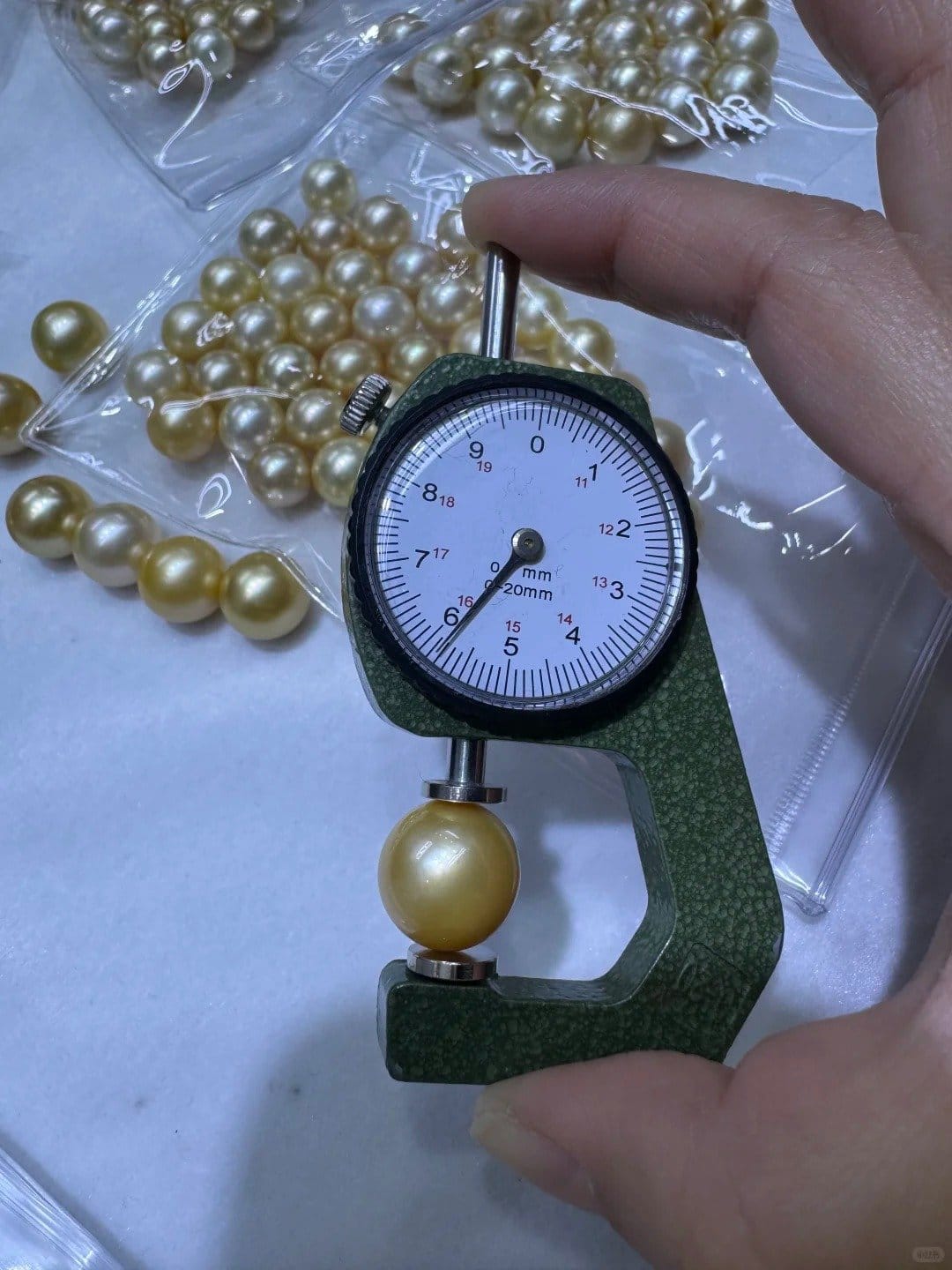
Here is what each size range actually looks like, with real-world analogies so you can visualize before you buy.
| Size Range | Visual Analogy | Freshwater Pearl Type | Typical Price Range (per strand) |
|---|---|---|---|
| – | |||
| 4-5mm | Small pea / peppercorn | Seed pearls, classic tissue-nucleated | $20-40 |
| 6-7mm | Standard pea / pencil eraser | Standard tissue-nucleated | $30-60 |
| 7-8mm | Large pea / jellybean | Quality tissue-nucleated | $50-100 |
| 8-9mm | Small marble / cherry pit | Upper tissue-nucleated, entry Edison | $80-150 |
| 9-10mm | Marble / dime coin | Edison, Ming, select tissue-nucleated | $120-200 |
| 10-12mm | Grape / penny coin | Edison, Ming | $150-300 |
| 12-14mm | Large grape / quarter coin | Large Edison, select Ming | $200-400+ |
What 1 Millimeter Actually Looks Like
The hardest part of buying pearls online is that 7mm and 8mm look identical in product photos. Here is what that 1mm gap means in reality:
- A 1mm increase adds roughly 20% more visual volume. Pearls are spheres, so diameter increase means the whole surface area grows, not just one dimension
- On a necklace, a 1mm difference across 50 pearls creates a dramatically thicker strand. The eye reads the cumulative effect, not individual pearl size
- On earrings, 7mm sits neatly on the earlobe while 8mm starts to project forward. That projection is what makes earrings look “dressier” versus “everyday”
- On a bracelet, 6mm feels like a whisper while 8mm reads as a clear statement. Bracelets are viewed at arm’s length, so every millimeter counts
The GIA notes in its pearl education guide that even trained gemologists use calibrated measuring tools for pearl size. The visual difference between adjacent sizes is subtle enough that estimation alone is unreliable.
How Freshwater Pearl Size Drives Price: The Exponential Curve

Pearl pricing follows the same logic as diamond pricing: bigger is rarer, and rarity does not increase linearly. It jumps exponentially.
The Price Multiplier at Key Thresholds
For freshwater pearls, three size thresholds create noticeable price jumps:
- The 7.5mm threshold: below this, freshwater pearls are abundant and affordable; above this, round specimens become scarcer and prices climb
- The 9mm threshold: only well-farmed tissue-nucleated pearls or bead-nucleated Edison/Ming pearls reach this size; prices typically double from the 7-8mm range
- The 12mm threshold: this is South Sea territory, and freshwater pearls that reach it (large Edison) are rare enough to command premium pricing
A concrete example: a 7-7.5mm freshwater strand might cost $40. The same quality at 8-8.5mm jumps to $70.
At 9-9.5mm, you are looking at $120-150. Each 1mm step compounds the previous increase.
But Size Is Not the Top Value Factor
The freshwater pearl grading guide explains the full quality hierarchy. Size ranks sixth out of seven value factors for freshwater pearls:
- Luster
- Surface quality
- Shape
- Color
- Matching
- Size
- Nacre thickness
This means a 7mm pearl with exceptional luster will outperform a 9mm pearl with mediocre luster every time, both in appearance and in long-term value. The size trap is real: paying more for bigger but duller pearls is the most common mistake first-time buyers make.
Choosing Freshwater Pearl Size by Jewelry Type
Each jewelry type has its own size sweet spot: the range where pearls look proportional, feel comfortable, and deliver the best value.
Freshwater Pearl Necklace Sizes
| Size Range | On-Neck Appearance | Best For | Price Sensibility |
|---|---|---|---|
| – | – | ||
| 6-7mm | Delicate, barely-there chain | Young women, first pearls, petite frames | Most affordable |
| 7-8mm | Classic “go-anywhere” strand | Everyday, office, casual, most women | Best value zone |
| 8-9mm | Noticeably luxurious | Professional settings, dressy occasions | Moderate premium |
| 9-10mm | Bold and commanding | Statement pieces, formal events | Higher investment |
| 10mm+ | South Sea-level impact | Luxury occasions, collectors | Premium pricing |
The best freshwater pearl necklace guide covers specific strand recommendations at each size. The key takeaway: 7-8mm is the freshwater necklace sweet spot. It delivers 90% of the visual impact of larger sizes at 40% of the cost.
Freshwater Pearl Earring Sizes
| Size Range | On-Ear Appearance | Best For | Comfort Note |
|---|---|---|---|
| – | – | – | |
| 6-7mm | Neat, subtle dot on earlobe | Everyday, second piercings, petite frames | Lightweight, no droop |
| 7-8mm | Classic pearl stud look | Most versatile, works everywhere | Perfect weight balance |
| 8-9mm | Noticeable projection | Dressy occasions, professional settings | Slightly heavier but stable |
| 9-10mm | Bold and eye-catching | Statement look, evening wear | Heavier , choose dangle style over stud if weight-sensitive |
| 10mm+ | Dramatic, South Sea look | Luxury occasions, collectors | Recommend drop/dangle style , studs this size can pull forward |
The freshwater pearl earrings guide and pearl stud earrings guide give style-specific recommendations. The rule: earrings read larger than necklaces at the same mm because they are isolated on the ear with no strand context. A 7mm earring looks equivalent to an 8mm necklace pearl.
Freshwater Pearl Bracelet Sizes
| Size Range | On-Wrist Appearance | Best For | Comfort Note |
|---|---|---|---|
| – | – | – | |
| 6-7mm | Whisper-thin strand | Petite wrists, understated style | Barely-there feel |
| 7-8mm | Standard bracelet weight | Most women, everyday wear | Good balance |
| 8-9mm | Substantial and visible | Bold everyday, dressy casual | Noticeable on wrist |
| 9mm+ | Statement bracelet | Formal occasions, larger wrists | Can feel heavy during all-day wear |
The freshwater pearl bracelet guide covers the comfort issue bracelets face: constant movement means weight matters more than for necklaces. 7-8mm is the bracelet sweet spot for the same reason it works for necklaces. Maximum visual presence with minimum comfort compromise.
Matching Freshwater Pearl Size to Your Body Frame and Occasion
Size choice is not just about preference. It is about proportion. The wrong size on the wrong frame creates jewelry that looks either invisible or overwhelming.
By Body Frame
| Frame Type | Necklace Sweet Spot | Earring Sweet Spot | Bracelet Sweet Spot |
|---|---|---|---|
| – | – | – | – |
| Petite (under 5’4″, slender) | 6-7.5mm | 6-7.5mm | 6-7.5mm |
| Average (5’4″-5’8″, medium build) | 7-8.5mm | 7-8mm | 7-8mm |
| Tall or larger frame (5’8″+, broader build) | 8-10mm | 8-9mm | 8-9mm |
The logic is simple: pearls should complement your frame, not compete with it. A 6mm necklace on a tall woman looks like a thread. A 10mm necklace on a petite woman overwhelms her neckline.
By Occasion
| Occasion | Recommended Size Range | Why |
|---|---|---|
| – | – | – |
| Everyday / casual | 6-8mm | Understated, comfortable for all-day wear |
| Office / professional | 7-8.5mm | Polished without being flashy |
| Bridal | 7-9mm | Romantic and visible in photos without dominating |
| Evening / formal | 8-10mm | Statement-worthy under formal lighting |
| Gift (safe choice) | 7-8mm | Universally flattering, hardest to get wrong |
The One-Size-Fits-Most Rule
If you are buying freshwater pearl jewelry as a gift or for yourself and cannot decide, 7-8mm is the answer. It is the freshwater equivalent of a 6-prong diamond solitaire, classic, proportional, and appropriate everywhere. The freshwater pearls everyday guide explains why this range works across all daily scenarios.
The Size Trap: When Bigger Freshwater Pearls Are Not Better
Three scenarios where paying for larger freshwater pearls actually hurts your purchase:
1. Bigger but Dull
A 9mm freshwater pearl with weak luster looks like a gray marble. A 7mm pearl with sharp, mirror-like luster looks like a gem. The eye reads luster first and size second. Always prioritize luster over size. The grading guide shows you how to evaluate luster before you consider millimeters.
2. Bigger but Baroque
Large freshwater pearls (9mm+) are far more likely to be baroque or oval-shaped. If you want round pearls, staying in the 7-8mm range gives you a much higher roundness rate. Going bigger means accepting shape imperfections. Or you pay significantly more for the few round specimens at larger sizes. The baroque freshwater pearls guide covers when baroque shape is actually desirable.
3. Bigger but Uncomfortable
Earrings above 9mm in stud style can pull forward on the earlobe. Bracelets above 9mm feel heavy during a full day of wear. Necklaces above 10mm can feel like carrying a rope around your neck. Size should serve comfort, not ego. Jewelry you do not want to wear is jewelry wasted, regardless of how impressive the millimeters look on paper.
Freshwater Pearl Size vs Other Pearl Types: The Complete Comparison
Understanding how freshwater pearl size compares to other types helps you decide whether freshwater is the right choice for the size you want.
| Pearl Type | Size Range | Price at 8mm | Price at 10mm | Sweet Spot |
|---|---|---|---|---|
| – | – | – | – | – |
| Freshwater | 4-14mm | $50-100 | $120-200 | 7-8mm |
| Akoya | 2-9.5mm | $150-300 | Rare/unavailable | 7-7.5mm |
| Tahitian | 8-16mm | $200-400 | $300-600 | 9-10mm |
| South Sea | 9-20mm | Unavailable (too small) | $500-1000 | 10-12mm |
The key insight: freshwater pearls give you access to sizes 7-10mm at prices no other type can match. Below 7mm, they are the cheapest option. Above 10mm, Edison freshwater pearls compete with Tahitian and South Sea visually at a fraction of the cost. The Akoya vs freshwater comparison breaks down the quality differences at each size range.
Freshwater Pearl Size FAQ
What size freshwater pearls should I buy for a first necklace?
7-8mm. This range is the universal sweet spot, classic enough for any occasion, affordable enough for a first investment, and proportional on nearly every body frame. It delivers the maximum visual impact per dollar spent.
How can I tell pearl size without measuring tools?
Use coin references: a 5mm pearl is roughly the size of a peppercorn, 7mm matches a pencil eraser, 8mm is a small marble, 10mm is close to a dime, and 12mm approaches a grape. For precision, ask the seller for the exact mm measurement. Reputable freshwater pearl vendors always specify.
Does freshwater pearl size affect durability?
Not directly. Durability depends on nacre thickness, not diameter. However, larger freshwater pearls tend to have thicker nacre because they spend more time in the mussel. The can freshwater pearls get wet guide covers nacre durability in detail.
Why do some 8mm freshwater pearls cost $30 and others cost $150?
Size alone does not set price. The $30 strand likely has lower luster, more surface blemishes, and less uniform shape. The $150 strand will have sharp luster, clean surfaces, and consistent roundness. Always compare quality factors alongside size. Two pearls at the same millimeter can be worlds apart in value.
Are Edison pearls worth the premium for larger sizes?
Yes, if you specifically want 9-14mm round freshwater pearls. Edison pearls use bead nucleation to achieve sizes and roundness that tissue-nucleated freshwater pearls rarely reach. At 10-12mm, an Edison strand costs $200-300 versus $500+ for Tahitian at the same size. The visual difference is modest but the price difference is dramatic. The Edison pearls guide details the trade-offs.
Get the Free Pearl Buying Checklist
7 quality checks, real price benchmarks, 5 traps to avoid , one 16-page PDF.
Free download. No spam. Unsubscribe anytime.
Related Pearl Guides
Keep learning with these hand-picked guides:
- Best Pearl Stud Earrings
- Best Freshwater Pearl Necklaces
- Best Pearl Drop Earrings
- How to Tell if Freshwater Pearls Are Real
- How to Clean Pearls
Still deciding between lengths? The pearl necklace length guide breaks down collar, choker, princess, matinee and opera with a pick-by-body table.