
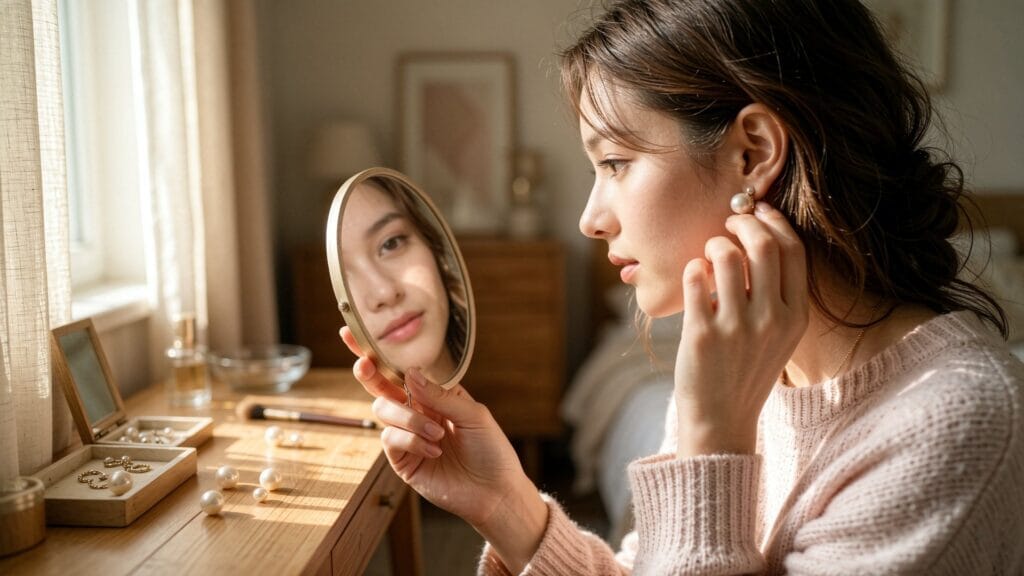
Before you spend a cent on pearls, keep one page open on your phone: a plain pearl quality checklist you can run through at the counter. Most buyers lose money not because pearls are complicated, but because sellers stack jargon on top of jargon until a 20 dollar bead sounds like a treasure. This guide condenses the quality rules that matter into seven checks you can finish in two minutes.
What You’re Actually Looking At Before You Buy
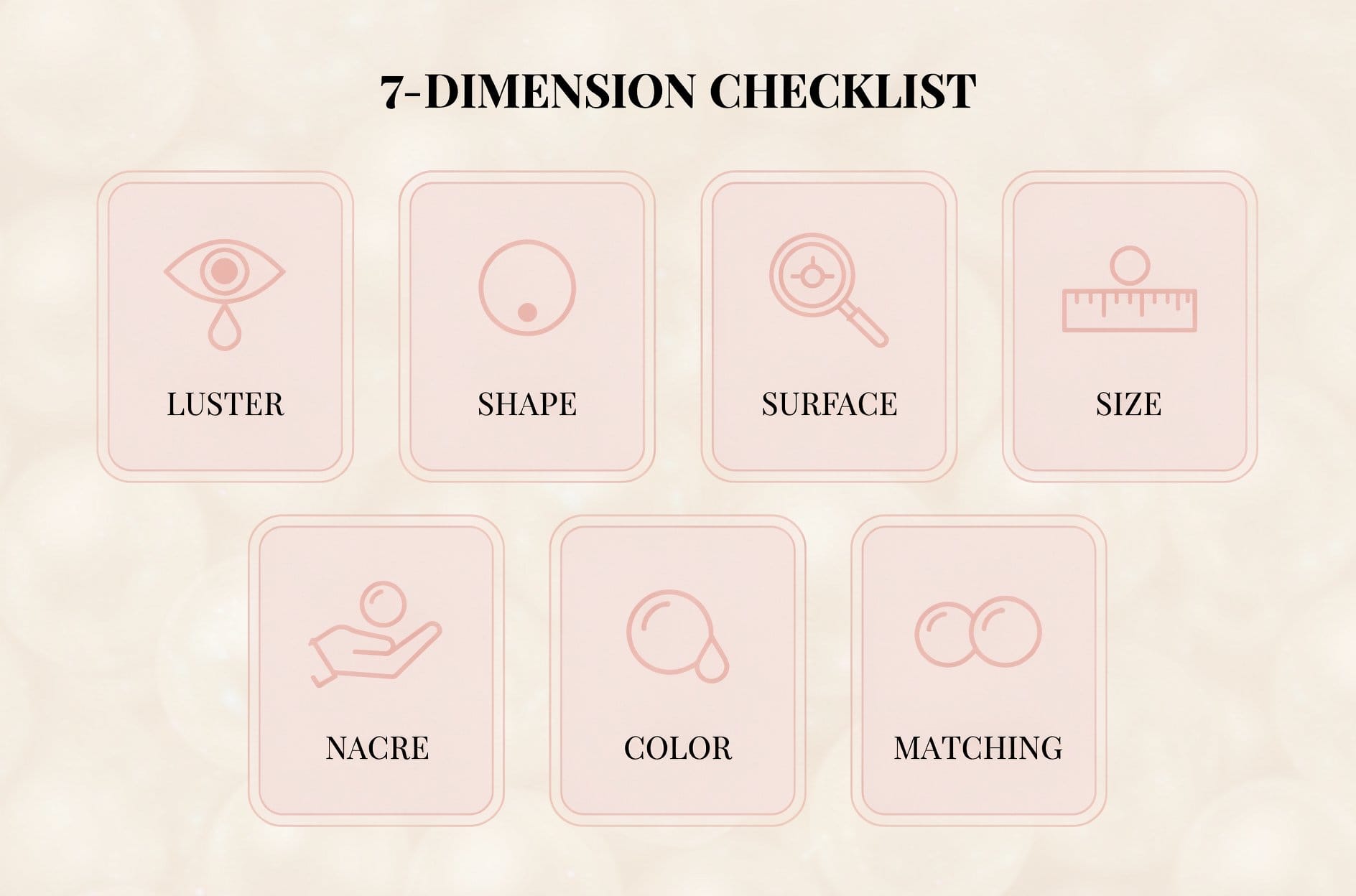
Marketing words like “aurora flawless” or “mirror shine” sound impressive and mean almost nothing on their own. Real quality breaks down into seven dimensions any shopper can learn: luster, surface, shape, size, color, matching, and nacre. You do not need a lab. You need daylight, patience, and a short list.
The point of this page is simple. Instead of reading thirty articles, save one pearl quality checklist and judge any strand or stud against it before you pay.
The 7-Dimension Pearl Quality Checklist
Here is the core list. For each dimension, read the good sign and the red flag, then trust your eyes.
| Dimension | Good sign | Red flag |
|---|---|---|
| Luster | Sharp reflection of nearby objects; you see depth, not a flat shine | Look of coated wax; dull, no depth |
| Surface | Tiny pits or faint lines, only visible up close | Dense pitting (a “pockmarked face”) |
| Shape | Near round reads identical to round at arm’s length | Lopsided or badly off round at a “round” price |
| Size | 6 to 9 mm sits right for daily wear | Steep premiums for size over luster |
| Color | Body color (white, pink, purple) is your call; soft orient is a bonus | Extra charges for a “rare” tint you cannot see |
| Matching | Strands and pairs look alike; small differences fine for daily wear | Top dollar for perfect match on a casual piece |
| Nacre | Thick nacre wears for years; freshwater non nucleated is solid nacre | Shell thin as an eggshell that flakes or peels |
Luster leads every list for a reason. Turn the pearl slowly under natural light. If you can see the outline of your finger on the surface, the luster is strong. If it looks like dull plastic, pass.
On nacre, the numbers help. A non nucleated freshwater pearl is solid nacre from center to surface, so the old “nacre thickness” question does not even apply. A bead nucleated Akoya carries roughly 0.3 to 0.8 mm of nacre (most often 0.4 to 0.6 mm). A bead nucleated Edison freshwater runs about 1 to 2 mm. Thicker nacre simply lasts longer. The Pearl Decoded freshwater pearl grading guide walks through how graders read each layer.
For the science of nacre itself, see the overview at Wikipedia.
Spotting Fakes: Real Lessons From the Zhuji Pearl Market
Zhuji, in Zhejiang province, sits at the center of China’s freshwater pearl trade. China produces about 95 percent of the world’s freshwater pearls, and Zhuji handles roughly 70 percent of that domestic volume. It is the best place to learn what a real pearl feels like, and the fastest place to meet a fake. Three cases from the market are worth remembering.

Case one: a custom jewelry live stream promoted “natural pearls with a professional certificate.” The parcel arrived as plastic beads, with a card stamped for 925 silver, shipped from a different factory than the one named on the stream. The large account pulled in viewers, a smaller account took the orders, the listing vanished, and questions were blocked.
Case two: a buyer ordered from a Zhuji stream promoted on a social app, then saw the parcel ship from a city in Henan, not Zhejiang. The seller called it a nearby warehouse. Pressed, they admitted the beads were shell pearl, not the freshwater pearl advertised. Real Zhuji pearls mostly ship from Zhejiang.
Case three: some streams sell shell pearls, pressed from shell powder, labeled “perfectly round and flawless.” Under a phone light, a real pearl shows a faint warm yellow tone; a bead that reads as fully clear white is usually fake. Buyers who asked were muted.
The pattern is consistent. Trust the object, not the script. The Pearl Decoded guide to the Zhuji pearl market explains how local buyers inspect goods in person before they commit.
Sales Talk Traps: How Sellers Use Jargon Against You
The same market teaches the sales playbook. Learn it and the pitches lose their grip.
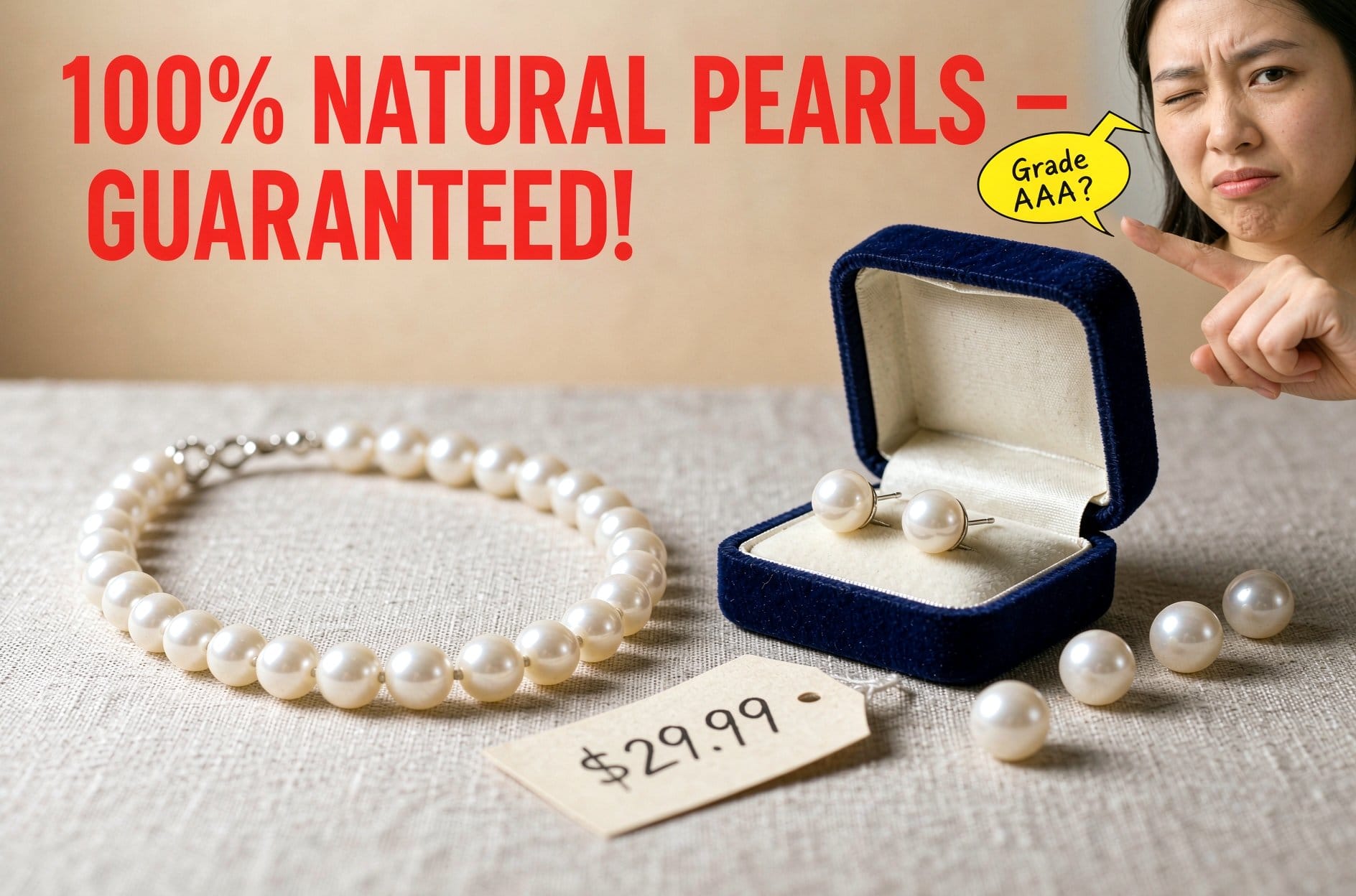
“Perfectly round, aurora flawless” sounds like a grade. It is usually a slogan. Round costs more, but near round looks the same at arm’s length and costs far less, so paying a round premium for a casual piece rarely pays.
Some sellers present a bead nucleated pearl as if it were non nucleated, then charge non nucleated prices. Others use “natural” to blur the line between a cultured pearl and a completely untreated one. Almost every pearl sold today is cultured. “Natural” on its own tells you little.
Certificates get waved as proof. A card means nothing if the pearl in your hand is not the pearl the card describes. Always match the bead to the certificate, not the certificate to the story.
One more trap: inflated “agent” prices. A few Zhuji shops quote a fake agency rate, then praise their own discount. The fix is boring and effective. Visit several shops, learn the posted prices first, then bargain. Do not fall for the room.
How To Choose At Every Budget (With Real Zhuji Price References)
Pearls reward patience more than wealth. Set the budget, then spend it on luster before surface.
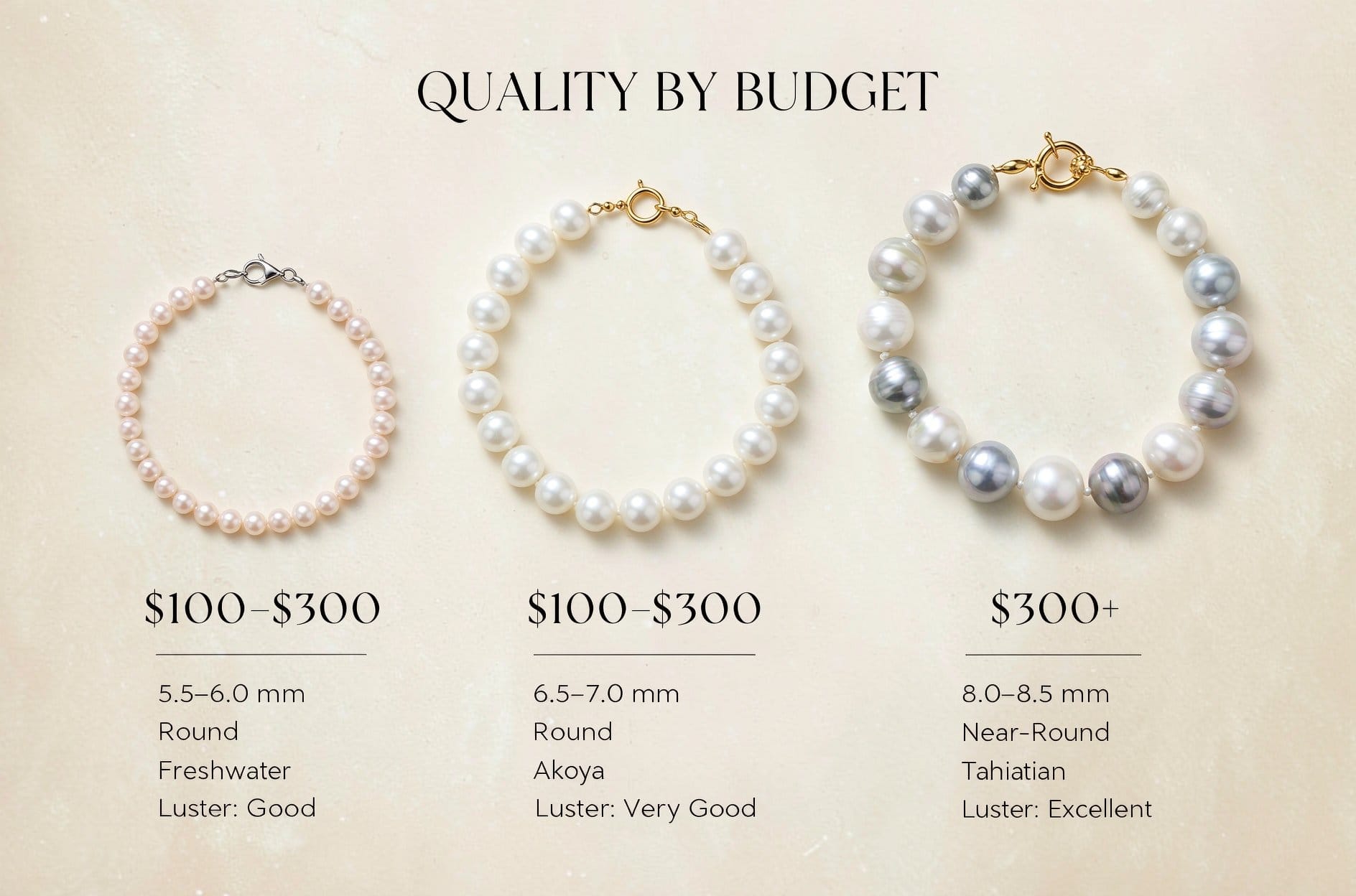
- Entry, under 500 yuan (about 70 USD): freshwater studs or a small pendant. Accept faint surface marks. Luster is the non negotiable.
- Mid, 500 to 1500 yuan (about 70 to 210 USD): a better matched strand or near round freshwater pair, from a source you can verify.
- Gift, 1500 yuan and up (about 210 USD plus): matched strands, Akoya or strong freshwater, with a certificate for peace of mind.
- Collection, 3000 yuan and up (about 420 USD plus): top luster, unusual color, or large baroque statement pieces.
Real market data helps frame this. In the Zhuji jewelry city, around 700 yuan (roughly 100 USD) can take home five pieces: a saltwater gourd twin pearl pendant, a rice grain chain, freshwater Akoya style studs, and fanta orange baroque beads. New buyers should first walk the clearly priced shops to learn the range, then bargain. The priority order stays the same: bright over round over flawless.
Step back and the structure is clear. Zhuji trades more than 1,000 tonnes of freshwater pearls a year and anchors most of China’s supply chain. Wholesale prices there run 60 to 75 percent below Western retail. That gap is exactly why “direct from source” marketing sounds tempting and why it pays to verify. The Pearl Decoded freshwater vs saltwater comparison breaks down where the real value sits between the two.
Do You Really Need a Certificate?
For daily wear, usually not. A certificate helps most when the price climbs into the thousands.
GIA is the most respected name and the most expensive to obtain. For most buyers, a national inspection card, the kind issued by Chinese gem labs, is enough and costs little. The card proves the item was graded by a lab, not by the person selling it.
The catch is the match. Certificates can be faked, and a real certificate can travel with the wrong pearl. The only check that matters is whether the bead in front of you is the bead the certificate describes. That is why the shell pearl with a silver card from case one still failed: the paper and the pearl never lined up.
The Pearl Decoded guide on telling real freshwater pearls from fakes covers the hands on tests you can run without any certificate. For the formal grading framework, GIA publishes a clear pearl quality factor reference.
A Budget-Tiered Checklist: What to Inspect at Each Price
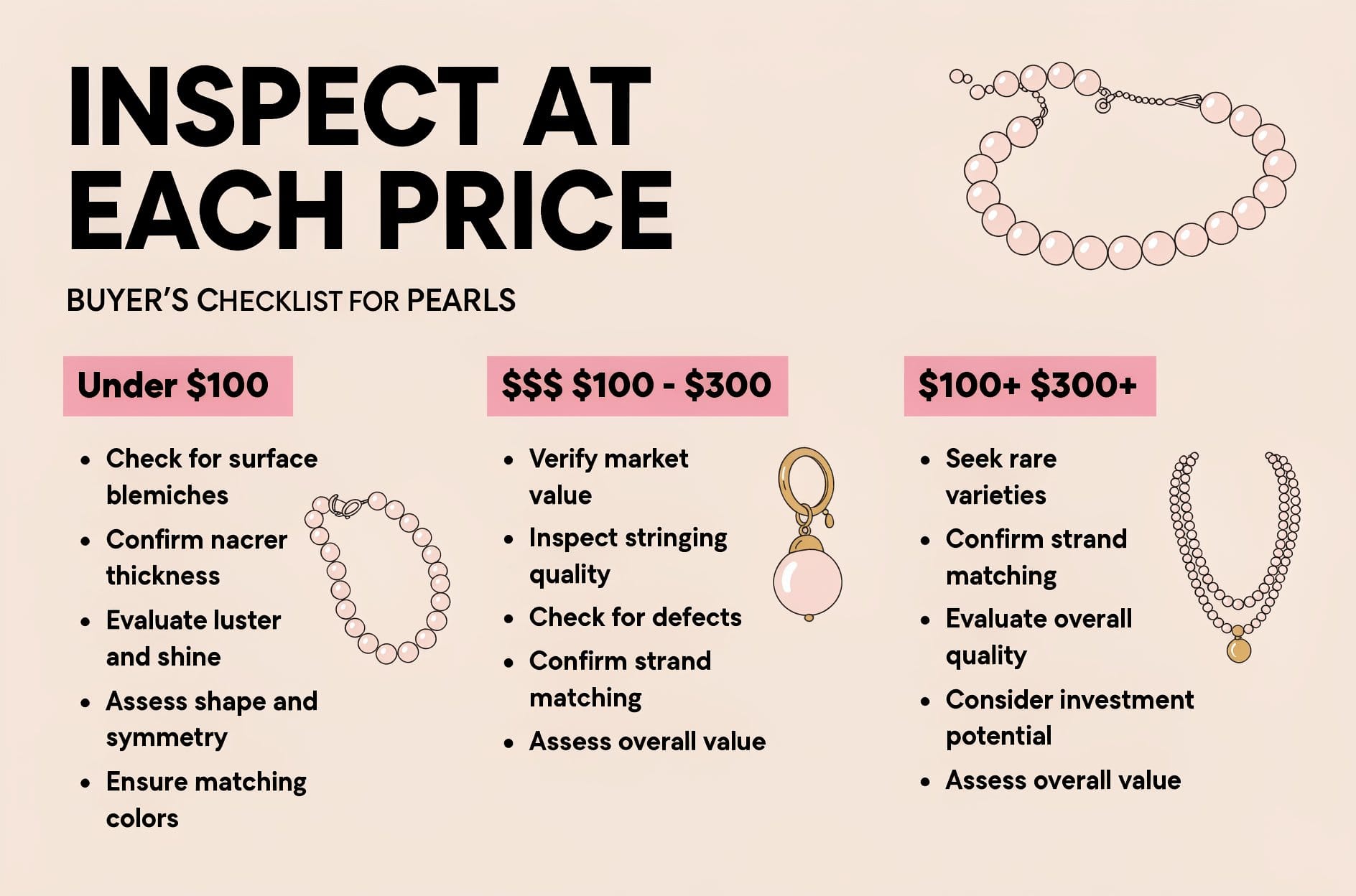
The quality checklist above does not change with price, but the bar you should hold moves with your budget. Regulars in the Zhuji pearl market are blunt about this: at the entry level, perfection is neither expected nor worth chasing. Spend where it changes how the pearl looks, not on a flawless grade sheet.
Under $50 (entry, gift, or trial): Prioritize luster and a clean, even surface you can see without a loupe. A slightly off-round shape is fine here; a dull, coated-looking surface is the automatic pass. Skip certificates entirely. The pearl is not worth the paper’s fee, and a seller pushing “GIA-certified” at this price is a red flag worth noting.
$50 to $150 (everyday wear, self-purchase): Hold the line on luster, meaning sharp reflected light rather than a waxy glow, and demand a surface free of dense pitting. Roundness starts to matter if you want studs; baroque is a smart, cheaper design choice. One matched pair beats five mismatched bargains.
$150 and up (gift, collection, heirloom): Now the full checklist applies. Luster, clean surface, true round or intentional baroque, a matched pair, and a verifiable source. At this tier a certificate from a recognized lab earns its keep, and a named, traceable seller matters more than a low sticker price.
The through-line is simple. Let your budget set how strict the checklist is, but never lower the luster bar. A cheap pearl with great luster beats a pricey dull one every single time.
The One-Glance Pearl Quality Checklist
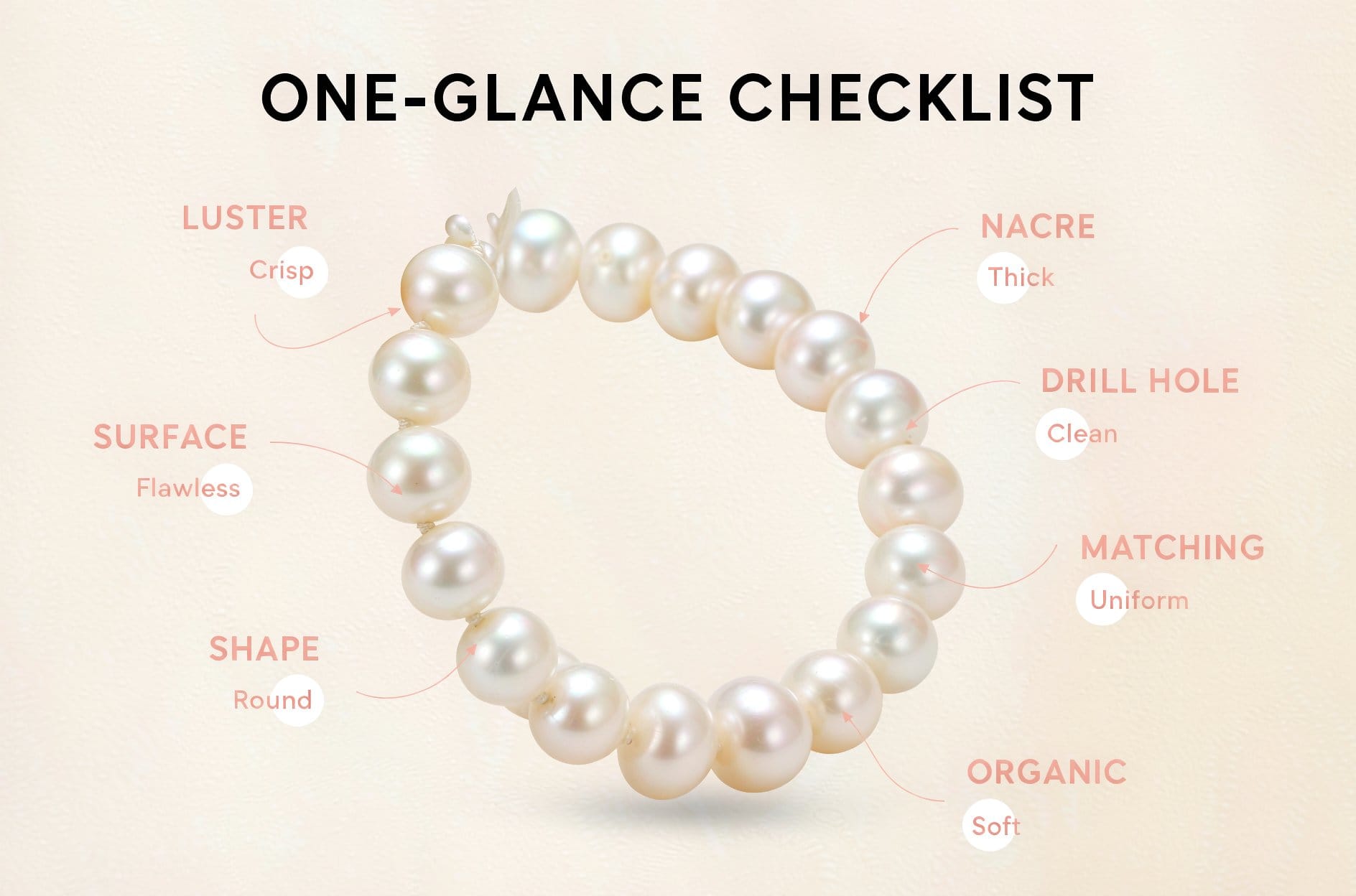
Save this and run it at the counter.
- Turn the pearl in daylight. Strong reflection means strong luster.
- Feel and squint the surface. Tiny marks are normal. A pockmarked face is not.
- Choose near round for value. Round is pretty, near round is smart.
- Match the certificate to the pearl, not the story to the card.
- Spend the budget on luster first, surface second, size last.
Six dimensions, one habit: trust the object. The rest is marketing.
Frequently Asked Questions
How often should I re-check my pearls?
Every six to twelve months is enough for pieces you wear often. Look for stretched silk on strung necklaces, loose clasps, and any dulling from trapped perfume or hairspray. Restring before a break, not after. A single snapped strand can scatter pearls you will never match again.
What is the most important factor in pearl quality?
Luster. It is the first thing the eye reads and the hardest trait to fake. A pearl with deep, sharp reflection outranks a flawless but dull one.
How can you tell if a pearl is real?
Read the luster, match any certificate to the actual bead, and buy from a channel you can verify. The Zhuji market cases show that shell pearls and plastic beads still reach buyers through slick streams, so the object always beats the pitch.
Are perfectly round pearls worth the premium?
For daily wear, rarely. Near round pearls look identical at arm’s length and cost far less. Reserve the round premium for pieces where symmetry is the point, like a matched strand for gifting.
Do freshwater pearls need a GIA certificate?
Not for everyday pieces. A national inspection card is enough and cheap. Reach for GIA only when the price climbs into the thousands and resale or proof matters.
What is a fair price for good freshwater pearls?
It tracks the budget tiers above. Entry pieces sit under 500 yuan, mid pieces 500 to 1500, and gift grade starts near 1500. In Zhuji, around 700 yuan can still build a five piece starter set, which shows how far patient buying goes.
A pearl quality checklist is not a test you pass once. It is the habit of checking before you pay. Keep the seven points on your phone, visit a real market if you can, and let luster lead. The pearl trade rewards the careful buyer every time.
Get the Free Pearl Buying Checklist
7 quality checks, real price benchmarks, 5 traps to avoid, one 16-page PDF.
Free download. No spam. Unsubscribe anytime.