
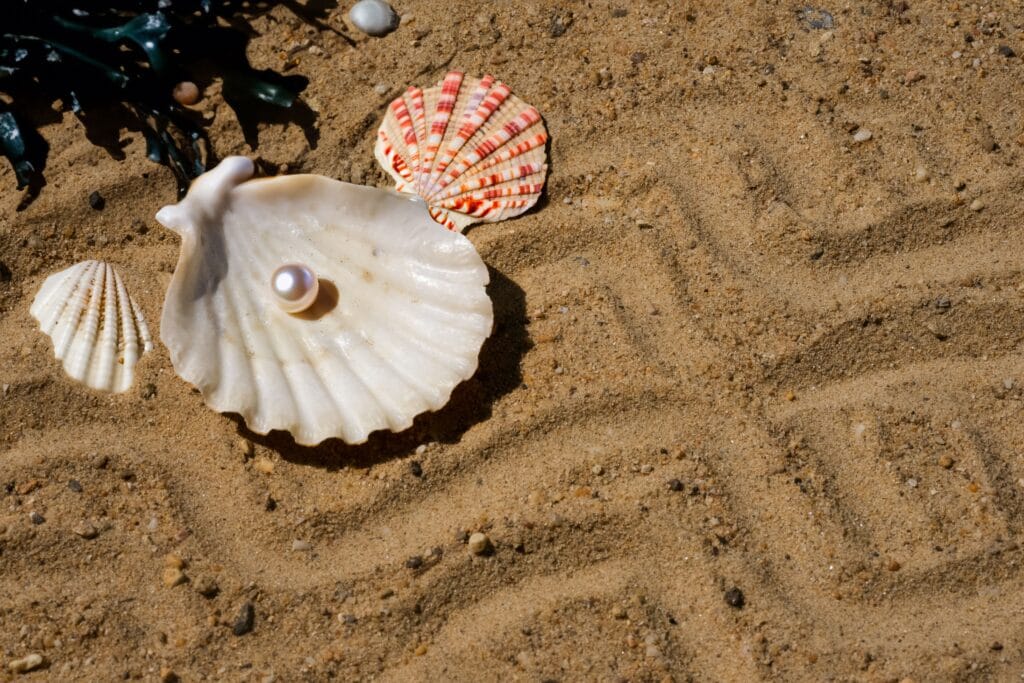
puts Tahitian vs freshwater pearls side by side so the budget question gets a clear answer before you buy.
At a Glance: The Two Pearls Side by Side
From Zhuji market visits: A Tahitian pearl at the Ruixue stall (BC0911) was quoted at 700 yuan (about $97), illustrating why genuine Tahitian pearls (often 10x+ the price of freshwater) remain luxury items. Most dark “Tahitian-style” freshwater pearls on the market are actually color-treated, so verify before paying saltwater prices.
The fastest way to see the difference is a direct comparison. The table below covers the five attributes buyers ask about most.
| Attribute | Freshwater Pearl | Tahitian Pearl |
|---|---|---|
| Origin | Freshwater rivers and farms, mainly China (Zhuji, Zhejiang) | Saltwater lagoons of French Polynesia |
| Nucleus | Nucleus-free, solid nacre throughout | Bead-nucleated (round shell bead inside) |
| Typical price (loose pearl) | From about $50 | $300 and up |
| Common size | 5 to 13 mm | 8 to 14 mm |
| Luster | Warm, soft glow | Sharp with multicolor overtone |
| Shape | Round to baroque, wide variety | Near-round to round more common |
For a broader saltwater comparison, see our freshwater vs saltwater pearls guide.
Price: Why Tahitian Pearls Cost 5 to 10x More
The price gap is not marketing. It comes from how the two pearls are grown.
Tahitian pricing logic. Tahitian pearls form inside the black-lipped oyster Pinctada margaritifera, a saltwater species that is sensitive and slow. A bead nucleus is inserted, then a nacre coating builds over two to three years. Harvest rates are low because many oysters reject the nucleus or fall to disease. Low supply plus a long cycle is what pushes the price up.
Freshwater pricing logic. Most freshwater pearls come from the triangle-shell mussel Hyriopsis cumingii, which is nucleus-free: the whole pearl is nacre. China produces roughly 95% of the world’s freshwater pearls, and the town of Zhuji in Zhejiang accounts for about 70% of China’s output. High volume and a simpler grow cycle keep the per-pearl cost low.
Real price ranges. A loose freshwater pearl can start around $50, while a loose Tahitian pearl typically runs $300 and up, with finished strands climbing far higher. The 5 to 10x gap is the normal spread, not a sale markup.
Luster & Look: The Feel Difference
This is where the two pearls stop being numbers and start being jewelry.
Tahitian overtone. The signature of a Tahitian pearl is its overtone, the thin color film over the base body color. Common overtones are peacock (green-gold), eggplant (deep purple), and blue-green. These overtones shift as the pearl turns under light, giving a depth that reads as expensive. GIA covers the science of this Tahitian cultured pearl coloring in its reference material.
Freshwater luster. Freshwater pearls show a warmer, softer glow. Recent high-luster freshwater lines have closed much of the gap and can look sharp in person, but they rarely show the multicolor peacock overtone that defines Tahitian goods. For close-up luster differences, our freshwater pearl grading guide breaks down what “high luster” means on the grading sheet.

Shape. Because Tahitian pearls grow around a bead, near-round and round shapes are more common. Freshwater mussels produce a wider mix, from round to baroque, which is part of their charm for casual wear.
Who Should Buy Which
The honest answer depends on the wearer, not the pearl.
Choose Tahitian if the budget is high, the goal is a collection piece, or the occasion is formal evening wear where a dark peacock pearl stands out. The unique overtone is the reason to pay more.
Choose freshwater if the pearl is for daily wear, a gift on a tight budget, or a first purchase where the risk of a bad buy should stay low. Freshwater gives the look of pearls at a fraction of the cost, which is ideal for building a habit before spending on rare goods.
Durability & Care
Both pearls are organic and need the same basic care, with one structural note.
Freshwater pearls are solid nacre with no bead inside, so there is no nucleus to crack if the pearl takes a knock. Tahitian pearls are bead-nucleated, which means a hard impact can in rare cases loosen or crack the nucleus. Neither pearl likes perfume, hairspray, or acid, so put pearls on last and take them off first. Wipe with a soft cloth after wear and store them away from harder gems.
How to Avoid Getting Ripped Off
The biggest scam in this category is dyed freshwater pearls sold as Tahitian black pearls. The price gap is 10x, so the temptation is real.
Check the overtone. A real Tahitian pearl shows overtone that moves with the angle and has depth. A dyed freshwater pearl looks flat and uniform, often a single dead black or a thin purple wash on the surface.
Check the certificate. A trustworthy seller provides a lab report from GIA or a comparable body. No certificate on a “Tahitian” pearl at a low price is a red flag.
Check the price. A genuine Tahitian pearl will not sell for $50. If the price looks too good, it is almost certainly not Tahitian. Pearl-market veterans in Zhuji, Zhejiang note that dyed freshwater goods are sometimes passed off as Tahitian. The safeguard is to ask for an overtone check and a certificate before paying. For a hands-on check, our guide on telling real freshwater pearls lists the at-home tests that catch most fakes.

Our Honest Take
Budget decides most of this.
Under $100, freshwater is the clear pick: low risk, real pearl, everyday wear. For a collection piece where the peacock overtone matters, Tahitian earns the higher price. The middle path is a high-luster freshwater pearl, which captures much of the shine at a small fraction of the cost.
Zhuji Market Field Notes: Three Rip-Off Patterns
Zhuji is the world’s freshwater-pearl hub, and the same market that hosts honest dealers also trains buyers to spot scams. Three patterns show up repeatedly in buyer reports, and knowing them saves more money than any discount code.
1. “Tahitian-color” freshwater sold as Tahitian. A strand of gray or peacock-tinted freshwater is labeled and priced as Tahitian. The tell: real Tahitian overtone shifts with the angle, while a uniform, flat color that looks identical from every side is almost always treated or dyed freshwater. The price gap is roughly tenfold, so the seller temptation is real.
2. The vague “cultured” label. “Cultured freshwater” and “cultured Tahitian” sound alike but are different pearls. Some listings lean on the shared word to imply saltwater origin. Read the species and the country, not the adjective in the middle.
3. Certificate theater. A glossy “certificate” from an unknown shop, or a QR code that leads to a dead site, proves nothing. A real lab report names the pearl, the treatment if any, and the origin. If the seller cannot name the lab, treat the paper as decoration.
4. Size and grade inflation. A 12 mm perfect-round Tahitian at a soft price deserves suspicion. Genuine top-grade Tahitian in that size is rare and priced to match. When a listing pairs impressive specs with a gentle price, the specs are usually the flexible part. Ask for the strand on a millimeter gauge, not a seller’s word.
None of this means avoid Zhuji. It means buy from a seller who answers the species, treatment, and origin questions directly, and walk when they will not.
The 60-Second Decision Matrix
If you have two minutes and a budget, use this to skip the noise. Match your situation to the row, then read only the one column that applies to you. This is how a first-time buyer can triage the choice in two minutes flat, before any sales pitch lands.
| If you… | Buy | Why |
|---|---|---|
| Want everyday wear under $100 | Freshwater | Cost per wear is unbeatable, and high-luster freshwater reads far above its price |
| Want a one-of-a-kind dark strand | Tahitian | Natural peacock overtone you cannot fake, plus real heirloom presence |
| Love the black look but watch the budget | High-luster freshwater (dyed or natural dark) | About 80% of the look at a fifth of the cost; verify dye if “Tahitian” is claimed |
| Buying a gift that must impress | Tahitian, or named freshwater | Recognizable value; keep the receipt and a real certificate |
The matrix is a starting point, not a verdict. The sections above explain the why behind each row, so read them before you commit to a purchase. A two-minute plan beats a two-hour regret.
Frequently Asked Questions
Are Tahitian pearls worth the money?
For buyers who want the peacock overtone and can wear them on formal occasions, yes. The price reflects low supply and a long grow cycle. For daily wear on a budget, freshwater delivers more value per dollar.
Can freshwater pearls look like Tahitian?
High-luster freshwater pearls can look surprisingly close in a casual setting, but they do not show the multicolor overtone that defines Tahitian goods. Under direct light the difference in depth is clear.
Why are Tahitian pearls so expensive?
They grow in a sensitive saltwater oyster, take two to three years to form, and have a low harvest rate. Limited supply against steady demand is what holds the price high.
How to tell dyed freshwater from real Tahitian?
Look at the overtone: real Tahitian shifts with angle and has depth, dyed goods look flat. Ask for a lab certificate, and treat any “Tahitian” pearl priced like a freshwater one as a fake.
Which lasts longer, Tahitian or freshwater pearls?
Lifespan depends more on care than on origin. Both are calcium carbonate and both scratch and acid-etch at similar rates. A well-kept strand of either can last decades. Freshwater’s solid nacre, with no bead inside, survives refinishing better, while a Tahitian’s thinner nacre is less forgiving of polishing. Store them dry and away from perfume, and both will outlast the trend that sold them. The real risk is not the pearl type, it is neglect.
What size Tahitian pearl is best for everyday wear?
8 to 10 mm is the sweet spot for daily wear. It is present enough to read as a real pearl yet small enough to sit comfortably under a collar or on a stud. Move to 11 to 13 mm for statement or evening looks. Freshwater gives you the same visual range plus 12 to 16 mm baroque options at a fraction of the cost, if size is the point rather than the species. For most buyers the 8 to 10 mm freshwater baroque is the quiet winner: wearable, distinctive, and easy on the wallet.
See two or three pieces in person before you commit, since screen photos flatten the very luster you are paying for.
Conclusion
Tahitian vs freshwater pearls is not a fight over which is “better”, it is a match of budget to goal. Freshwater wins on value and daily wear; Tahitian wins on rarity and overtone. Pick by the occasion and the wallet, and use our pearl quality checklist to judge any pearl before you pay.
Get the Free Pearl Buying Checklist
7 quality checks, real price benchmarks, 5 traps to avoid, one 16-page PDF.
Free download. No spam. Unsubscribe anytime.