
You spot a strand of golden South Sea pearls and the $800 price tag stops you cold. A few tabs later, you find freshwater pearls in a soft golden-pink tone for a fraction of the cost. The shapes look similar. The glow is close. So what exactly are you paying ten times more for? This guide puts South Sea vs freshwater pearls side by side, then breaks down the price gap by origin, nacre, color, size, and who each pearl actually suits. By the end you will know whether the premium is worth it for your budget and your wrist.
At a Glance: The Two Pearls Side by Side
Zhuji market research: A 12-13mm golden South Sea pearl runs around 1,700 yuan ($236), while a Tahitian-style freshwater (“True Mulberry”) is treated and far cheaper. The saltwater premium reflects slower growth and tighter supply control, which is why South Sea and Tahitian pearls stay luxury-priced for most buyers.
The fastest way to see the gap is a direct comparison. South Sea pearls come from the large Pinctada maxima oyster and are almost always bead-nucleated, one pearl per shell. Freshwater pearls come from mussels, are usually non-nucleated (the whole bead is solid nacre), and a single mussel can host many pearls at once. That single fact, one pearl versus many, explains most of the price difference. Reading the table top to bottom shows the two pearls diverge on every axis that costs money: yield per shell, farm time, and the natural size ceiling.
| Trait | South Sea | Freshwater |
|---|---|---|
| Origin | Australia, Indonesia, Philippines | China (Zhuji trading hub) |
| Mollusk | Pinctada maxima oyster | Hyriopsis freshwater mussel |
| Nucleus | Bead-nucleated (one per shell) | Usually non-nucleated (solid nacre) |
| Culture period | 2 to 4 years | 6 months to 2 years |
| Price range | $300 to $5,000+ loose | $20 to $200 |
| Common sizes | 9 to 20 mm | 3 to 16 mm |
| Luster | Satin, soft metallic | Mirror-bright, warm |
| Shape | Round to near-round | Round to baroque |
Price: Why South Sea Pearls Cost 10x More
The gap is not clever marketing. It is supply. South Sea farming is slow, risky, and low-yield, while freshwater farming is fast, scalable, and dense. When you pay more, you are mostly paying for how rare the pearl is to produce, not for a fundamentally different material.
South Sea Pricing Logic
South Sea pearls grow in Pinctada maxima, the largest pearl oyster. Each shell is nucleated with one bead and produces roughly one pearl. The oyster is sensitive, the growing window is long (often 2 to 4 years), and farms sit in a small band of warm Australian, Indonesian, and Philippine waters. Annual yield is low, and only a small share reaches true round, clean, golden grade. Scarcity sets the floor price.
Freshwater Pricing Logic
China dominates global freshwater pearl output. The trading hub of Zhuji (Shanxiahu town) handles on the order of 70% of the country’s production, according to China Daily and Xinhua reporting. Freshwater mussels are nucleated with several to dozens of implants at once, or not nucleated at all, so a single mussel can return many solid-nacre pearls. Mass scale spreads the cost, which is why a pretty freshwater strand can land under $100. That concentration is also why Zhuji prices tend to move the whole freshwater market at once.
Real Price Ranges
Expect South Sea loose pearls around $300 to $5,000 each, with finished strands climbing well above that for matched rounds. Freshwater pearls typically run $20 to $200, graded by size, luster, and surface. The overlap you sometimes see is the trap: a cheap treated freshwater pearl dressed up to look like the expensive one.
The Price Trap
The most common bait is dyed white freshwater pearls sold as natural golden South Sea. The dye is cheap. The markup is tenfold. Section 8 shows how to spot it before you pay. For a broader buying framework, the pearl quality checklist walks through what to inspect on any strand.
Color and Luster: The Look Difference
Both pearls can be beautiful. They just glow differently, and the difference matters more in person than in a photo.
South Sea Metallic Tone
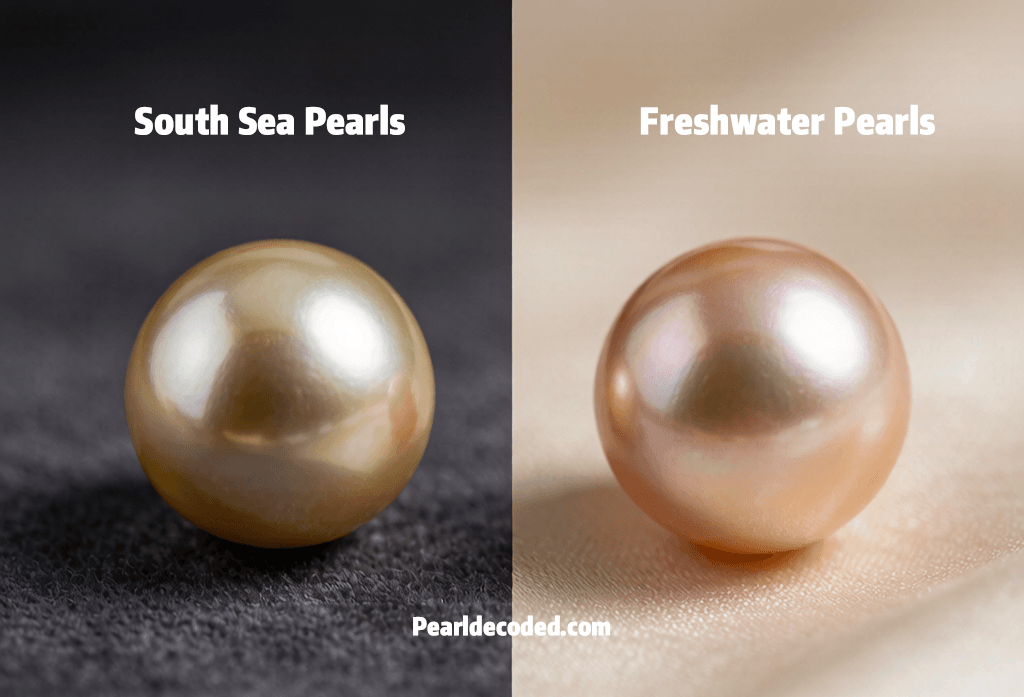
Natural golden South Sea pearls show deep golden, champagne, or white body colors with a soft metallic sheen. The deep golden tone is the scarcest and most prized. Color comes from the oyster, not from treatment, which is part of why it commands a premium.
Freshwater Palette
Freshwater pearls span white, pink, lavender, and champagne. Breeding improvements in recent years have pushed color and luster upward, so a top freshwater pearl can read surprisingly close to a South Sea pearl at a glance. The Chinese freshwater pearls guide covers these newer tones in detail.
Luster Contrast
South Sea luster tends toward a satin, almost velvety glow. Freshwater luster is usually sharper and more mirror-like, sometimes warmer. Neither is “better” by rule. They simply read as different materials, which is exactly why a side-by-side view (see the comparison above) settles the question faster than any description.
Size: The Size Premium
Size is where price curves bend sharply. A small jump in millimeters can mean a large jump in cost.
South Sea 9 to 20 mm
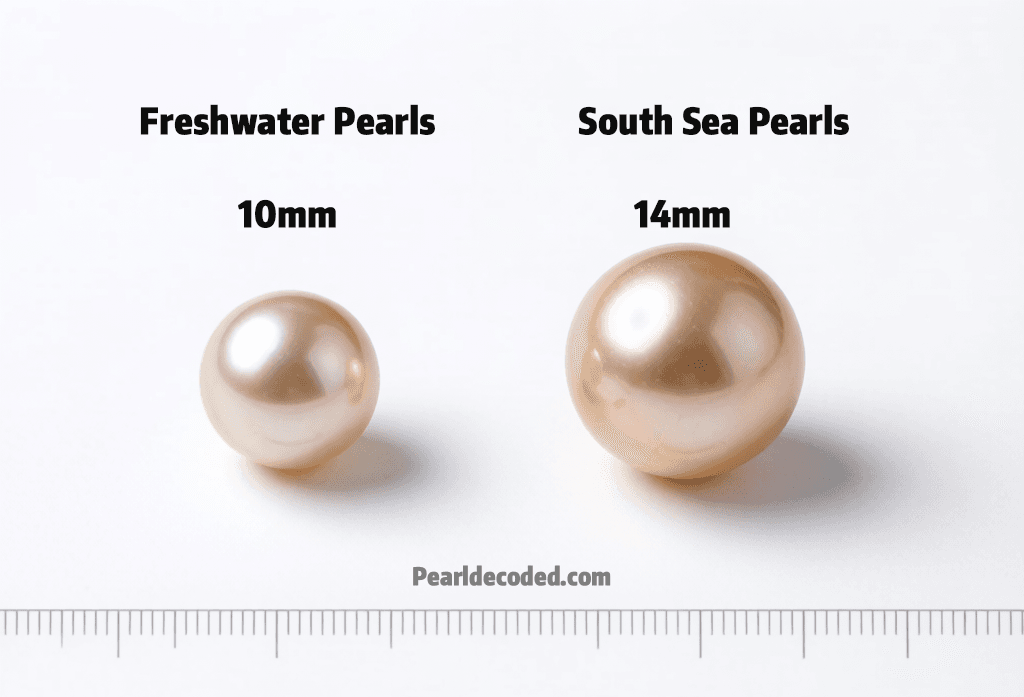
South Sea pearls start where many freshwaters stop. At 9 to 20 mm, bigger is rarer, and the price climbs in steps rather than a straight line. A 15 mm clean round golden South Sea is a different asset class from a 10 mm one.
Freshwater 3 to 16 mm
Freshwater pearls commonly sit at 7 to 10 mm, with 14 mm and up reached through Edison-style nucleated farming. You can get a large freshwater look without the South Sea price, though the glow and rarity still differ.
Same Size, Different Price
Put a 10 mm South Sea next to a 10 mm freshwater and the gap is not size, it is origin, nacre quality, and yield. The South Sea costs more because far fewer 10 mm rounds survive the longer, slower farm cycle. You pay for the odds, not the millimeter.
Who Should Buy Which
The right pearl is the one that fits your wear pattern and your wallet. Use this as a quick decision tree.
Choose South Sea If
You have the budget for an investment-grade piece, want a heirloom or evening-wear statement, love the natural golden tone, or need the gifting “wow” factor. A matched South Sea strand reads as jewelry with staying power.
Choose Freshwater If
You wear pearls daily, are building a collection on a sensible budget, like stacking multiple strands, or want to try a trend color without a big commitment. Freshwater also pairs well with the freshwater versus saltwater basics if you want the full picture.
The Middle Ground
High-quality golden freshwater pearls are a fair stand-in when the South Sea price is out of reach. You trade some rarity and satin depth for a fraction of the cost, and most casual observers will not tell the difference. Treat it as an affordable alternative, not a fake.
Durability and Care
Durability tracks nacre thickness. South Sea pearls are bead-nucleated, and the nacre coating the implanted bead is commonly 2 to 4 mm. For comparison, Akoya nacre is typically 0.3 to 0.8 mm and nucleated Edison freshwater sits around 1 to 2 mm, per standard grading references. Non-nucleated freshwater pearls are solid nacre top to bottom, so there is no thin coating to worry about at all. For the mollusk background behind these numbers, the pearl overview at Wikipedia is a plain-English starting point. All pearls are soft (Mohs 2.5 to 4.5), so keep them away from perfume, hairspray, and sweat. Wipe with a soft cloth after wearing, store flat, and let them rest a day between wears. With basic care, either type lasts decades.
How to Avoid Getting Ripped Off
The single biggest risk in this category is buying a treated freshwater pearl at a South Sea price. Know the three tells before you shop.
Dyed Freshwater vs Real South Sea
Natural golden South Sea color has a gentle gradient and depth. Dyed freshwater color is often flat and uniform, with the dye pooling in cracks or near the drill hole. The fastest proof is a certificate: a grader such as GIA or SSEF will state whether the color is natural. For high-value buys, insist on one.
“South Sea Color” Marketing Speak
Some listings call golden freshwater “South Sea color” or “South Sea style.” That wording is legal but misleading. Color is not origin. Read the species and the certificate, not the adjective in the title.
Channel Pitfalls (Zhuji Field Notes)
Zhuji market veterans note a recurring pattern: a seller shows a bright golden strand, names a low freshwater price to build trust, then “upgrades” you to a “real South Sea” strand at ten times the cost with only a verbal claim of origin. The safeguard is simple. Buy from sellers who show a lab certificate per strand, ask the species in writing, and walk away from any “trust me” pricing. These notes come from Zhuji trading-floor experience, not from a single shop, so treat them as a buying habit, not an accusation.
Frequently Asked Questions
Are South Sea pearls worth the money?
For a once-in-a-lifetime strand or an heirloom, yes. The rarity, size, and satin glow are real. For daily fashion, high-quality freshwater gives more looks per dollar.
Can freshwater pearls look like South Sea?
Up close, a top golden freshwater can read close to a South Sea pearl, especially in photos. In person, the luster and tone differ, and a side-by-side view reveals it quickly.
Why are South Sea pearls so expensive?
Low yield, long farm time, one pearl per shell, and a small growing region. Scarcity, not markup alone, sets the price.
How do you tell dyed freshwater from real South Sea?
Check for flat uniform color and dye near the drill hole, then ask for a GIA or SSEF certificate stating natural color. A verbal “real South Sea” is not proof.
Which lasts longer, South Sea or freshwater?
Both last decades with basic care. Non-nucleated freshwater is solid nacre, while South Sea carries a thicker nacre coat than Akoya. Avoid chemicals and both stay bright for years.
What size is best for investment?
Round South Sea pearls at 13 mm and up, with clean surfaces and strong color, hold value best. Size and roundness drive resale more than brand.
Conclusion: Budget-Tiered Advice
Match the pearl to the budget and the occasion, not to the hype. Under $200 buys a solid freshwater strand for daily wear. Around $300 to $500 gets you a high-quality golden freshwater look as a South Sea alternative. From $500 up you enter real South Sea territory for an entry piece. Past $1,500 you are in collector-grade South Sea, where size, roundness, and color decide the price. Set a hard ceiling before you shop so a smooth-talking seller cannot talk you past it. Want the full freshwater background first? The Tahitian versus freshwater comparison is a useful companion read.
Get the Free Pearl Buying Checklist
7 quality checks, real price benchmarks, 5 traps to avoid , one 16-page PDF.
Free download. No spam. Unsubscribe anytime.